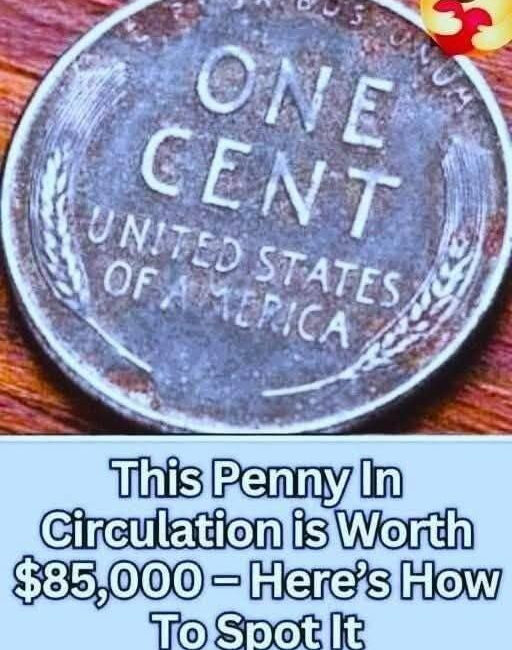
Here is the fascinating part: many rare pennies were never officially recalled.
They entered circulation decades ago.
Some were spent on groceries.
Some were used in vending machines.
Some were placed in piggy banks.
And some are still out there.
Unlike rare stamps or artwork, coins are meant to circulate. That means a fortune could be sitting unnoticed in a jar of change.
The odds are low.
But they are not zero.
The Psychology of Overlooked Value
Why do people miss valuable coins?
Because expectation shapes perception.
If you expect a penny to be worthless, you will not examine it closely.
Human brains filter information constantly. We ignore common objects to conserve mental energy.
That filtering system is efficient — but it also causes us to overlook anomalies.
Collectors train themselves to see differently.
They do not see “a penny.”
They see date, mint mark, luster, weight, metal tone, strike quality.
They see possibility.
How to Check Your Pennies Safely
If you are curious whether you might own something valuable, follow a disciplined approach:
- Check the date.
- Examine the mint mark.
- Look for doubling in lettering.
- Test magnetism for 1943 and 1944 coins.
- Weigh suspicious coins.
- Avoid cleaning.
- Consult a reputable coin dealer for authentication.
Authentication matters. Counterfeits exist, especially for famous coins like the 1943 copper cent.
Professional grading services encapsulate coins and verify authenticity.
Without authentication, value is uncertain.
The Broader Lesson: Mistakes Create Rarity
At its core, the $85,000 penny story is about error.
The Mint did not intend to create these rarities.
They are artifacts of imperfection.
But those imperfections, preserved across decades, became treasure.
There is something philosophically interesting about that.
Industrial systems aim for uniformity. Perfection. Consistency.
Yet the objects most prized by collectors are the deviations.
The wrong metal.
The misaligned die.
The doubled lettering.
Human systems create value through intention.
Markets create value through rarity.
And sometimes rarity is born from accident.
Could You Really Find One?
Statistically, the chances are slim.
Billions of pennies have been minted. Only a handful of high-value errors exist.
But people have found them.
Children have discovered rare coins in inherited jars.
Collectors have found transitional errors in bank rolls.
Estate sales have revealed forgotten treasures.
The key difference is awareness.
Most people never look.
Why the Story Endures
The idea of an $85,000 penny captivates people because it challenges assumptions.
It suggests that value is not always obvious.
It suggests that wealth can hide in plain sight.
It suggests that knowledge — not luck alone — unlocks opportunity.
That narrative resonates deeply.
Because it mirrors life beyond coins.
The Penny as a Symbol
The penny is often dismissed as trivial.
Some countries have eliminated their lowest denomination coins entirely.
Yet the humble one-cent piece carries history, artistry, economics, and sometimes extraordinary rarity.
It reminds us that:
- Mass production does not eliminate uniqueness.
- Small differences can have massive consequences.
- Attention changes outcomes.
The next time you receive change, pause before dropping it into a jar.
Look at the date.
Notice the color.
Feel the weight.
Because once in a very great while, an ordinary coin becomes something extraordinary.
And someone who decided to look closely walked away with far more than one cent.