Look around your daily environment.
Your eyeglasses contain minuscule hinge screws that allow smooth folding.
Your zipper relies on small metal guides.
Your seatbelt latch contains spring-loaded steel components that must lock instantly during impact.
Your laptop hinge includes reinforcement brackets hidden beneath plastic casing.
You rarely see these parts.
You rarely think about them.
Yet your daily comfort depends on them.
Even household appliances—washing machines, ovens, refrigerators—contain dozens of small structural reinforcements and conductive tabs.
Without them, systems rattle, loosen, or fail.
The world runs quietly on metal fragments.
Craftsmanship: From Blacksmiths to CNC Machines
Historically, metal shaping began with blacksmiths hammering heated iron into shape. Precision was achieved through skill and repetition.
Today, computer numerical control (CNC) machines carve components from solid blocks of metal with breathtaking accuracy. Laser cutters slice sheets of steel into intricate forms within milliseconds.
Mass production facilities stamp thousands of identical parts per hour.
Yet craftsmanship remains essential.
Even in automated factories, engineers design tooling. Technicians calibrate machines. Quality inspectors measure tolerances with digital micrometers.
What looks like an insignificant sliver of metal may represent:
- Advanced software modeling
- Specialized tooling
- Skilled labor
- Quality assurance protocols
Simplicity on the outside often masks complexity beneath.
The Philosophy of Uncertainty: Why Not Knowing Feels Refreshing
Modern life encourages instant resolution. We search, scan, and scroll for immediate clarity.
Yet there is something deeply satisfying about holding a question without rushing to answer it.
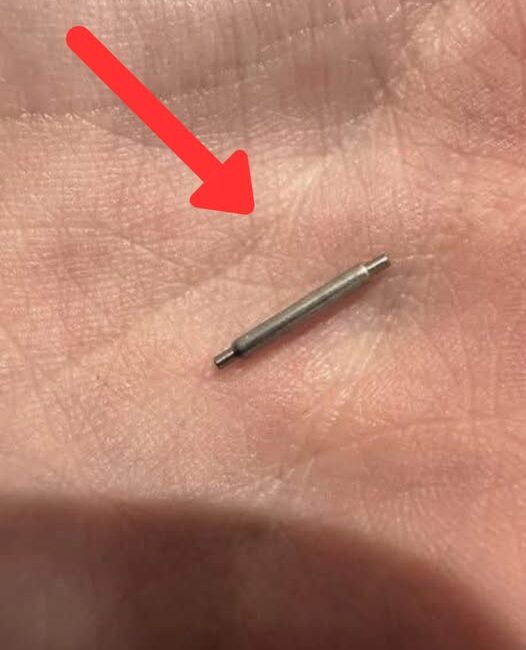
An unidentified metal object invites imagination. It might have traveled across continents inside a shipment. It might have fallen from a device mid-repair. It might belong to something entirely unexpected.
Uncertainty invites storytelling.
And storytelling reconnects us to a tradition older than databases: observation and deduction.
Before digital archives, people studied objects carefully. They learned through touch, experimentation, and reasoning.
A small metal puzzle reconnects us to that slower rhythm.
Learning to Observe: Building Analytical Vision
Examining a tiny object teaches subtle skills.
You notice weight distribution.
You test magnetism.
You inspect wear marks for friction patterns.
You observe whether edges are machined or stamped.
These observations cultivate analytical thinking.
Even if you never identify the object conclusively, the process strengthens attention to detail.
Attention to detail underlies engineering, medicine, craftsmanship, and art.
Looking closely at small things reshapes how we approach large problems.
Systems Thinking: Why Components Matter More Than We Realize
Every major system—bridges, aircraft, computers, power grids—depends on networks of smaller components.
Remove a single bolt from a suspension bridge and nothing dramatic happens immediately. Remove enough over time, and structural integrity collapses.
Complex systems are not held together by grand gestures. They are stabilized by small, repeated, reliable parts.
In medicine, precision instruments depend on micro-scale metal components. In renewable energy systems, connectors and brackets ensure alignment and stability.
Even satellites orbiting Earth contain tiny fasteners that endure temperature swings between extreme heat and cold.
Small does not mean insignificant.
Often, small means essential.
A Reflection on Human Ingenuity
Tiny metal objects embody human ingenuity in condensed form. They reflect:
- Material science advancements
- Mechanical reasoning
- Industrial evolution
- Collaborative engineering
Each component is a solution to a problem—often a problem you never noticed existed.
A hinge must open smoothly thousands of times. A clip must hold tension without snapping. A bracket must distribute force evenly.
These are not trivial tasks.
They are quiet achievements.
Why the Smallest Objects Inspire the Greatest Wonder
Ultimately, the magic of discovering a small metal fragment lies in perspective.
It reminds us that the world is layered with invisible design.
It encourages curiosity over complacency.
It challenges the assumption that importance correlates with size.
In an era defined by automation and predictability, stumbling upon something unexplained is a gift. It slows the pace. It opens space for imagination.
You may never learn exactly where that tiny piece of metal came from.
But perhaps that is not the point.
The point is the pause.
The moment of inspection.
The awareness that beneath every device, every structure, every system lies a hidden universe of carefully engineered parts.
And in that awareness, something beautiful happens.
Curiosity awakens.
Wonder returns.
✨ Sometimes, the grand adventure begins not with a mountain or a rocket launch, but with something no larger than a fingertip. A silent, shining puzzle. A fragment of possibility. A reminder that even the smallest pieces of our world carry extraordinary stories. ✨