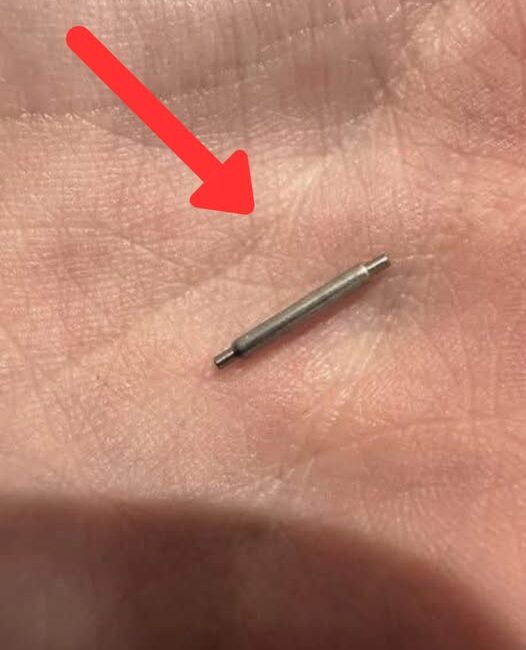
Every so often, you find something small and metallic resting on a desk, tucked into a pocket, or lying unnoticed on the floor. It catches the light in a way that feels deliberate. Maybe it is polished and reflective like a fragment of a mirror. Maybe it is matte, brushed, faintly scratched, marked with subtle lines left behind by machinery. Sometimes it feels heavier than it should. Other times, it seems almost impossibly light.
You pick it up.
You rotate it slowly between your fingers.
You tilt it toward the light.
You search for markings, engravings, clues.
Nothing.
No logo. No instructions. No obvious function. No immediate context. Just a small, quiet puzzle resting in your palm.
Often no larger than the tip of your finger, these tiny components feel like compressed stories—condensed fragments of a larger system that has now vanished from view. And suddenly, without warning, curiosity awakens.
Where did it come from?
What was it designed to do?
Why is it shaped exactly like this?
At first glance, these questions seem simple. But they carry surprising depth. In a world saturated with instant answers, encountering something that refuses to explain itself feels almost revolutionary. It slows us down. It demands observation. It invites investigation.
And that is where the real story begins.
The Power of Small Things: Why Size Is a Misleading Metric
Human attention is biased toward scale. We admire skyscrapers, massive engines, rockets, bridges, and satellites. We associate size with importance. But history repeatedly teaches a different lesson: the smallest components often determine the success or failure of the largest systems.
During the Industrial Revolution, monumental steam engines captured public imagination. Yet those engines depended on countless smaller parts—bolts, rivets, pins, gears, and springs. Remove one seemingly insignificant retaining clip, and the entire machine could seize.
That principle has not changed. It has only intensified.
Modern technology is built upon miniaturization. Inside a smartphone lies a dense ecosystem of microscopic screws, conductive tabs, grounding clips, brackets, shielding plates, and connectors. Many are nearly invisible without magnification. Yet each plays a precise role.
A tiny, unmarked piece of metal you discover could belong to:
- A grounding clip from a circuit board
- A hinge bracket from a laptop
- A retention spring from a mechanical watch
- A micro fastener from a camera lens assembly
- A structural reinforcement from a household appliance
- A calibration element from laboratory equipment
- A retaining pin from a bicycle brake system
To the untrained eye, these fragments look nearly identical. But to an engineer, subtle details reveal entire narratives: the curvature of a bend suggests tension. The alloy hints at environmental conditions. The diameter of a hole reveals compatible fasteners. A slight groove indicates alignment with a neighboring component.
Small parts are not afterthoughts. They are structural decisions.
Engineering Hidden in Plain Sight: The Invisible Intelligence of Design
What appears simple is often the result of astonishing complexity.
Consider a basic metal clip. It might look like a folded sliver of steel. But its design likely involved:
- Computer-aided design modeling
- Stress analysis simulations
- Prototyping and testing
- Material selection based on corrosion resistance and tensile strength
- Precision stamping or CNC machining
- Heat treatment to alter hardness
- Surface finishing for durability
- Dimensional inspection down to micrometers
The modern engineering process is rigorous. Software predicts how a component will respond to vibration, thermal expansion, mechanical load, and long-term fatigue. Manufacturing tolerances—tiny allowable deviations in size—are measured in thousandths of a millimeter.
In aerospace, for example, even a small fastener must endure extreme pressure and temperature shifts. Aircraft manufacturers rely on thousands of precision parts to ensure safety. One small bracket failing under stress could have cascading consequences.
Similarly, in medicine, surgical instruments contain miniature components that must operate flawlessly. Devices used in minimally invasive procedures depend on fine metal linkages and spring systems. Precision is not optional.
In automotive engineering, retaining clips secure brake lines and fuel connections. These parts endure vibration, heat, moisture, and mechanical strain. Their failure could compromise safety.
The smaller the part, the less visible its importance. Yet often, the smaller the part, the higher the precision required.
The Materials Matter: Why Metal Choice Tells a Story
If you hold an unidentified metal object long enough, you may notice its density, magnetism, or resistance to corrosion. These clues reveal more than you might expect.
Different metals serve different purposes:
- Stainless steel resists corrosion and is common in kitchen appliances and medical tools.
- Aluminum is lightweight and often used in electronics and aerospace.
- Brass offers conductivity and is common in electrical connectors.
- Titanium provides exceptional strength-to-weight ratio and is used in high-performance engineering.
Material selection is never random. Engineers choose alloys based on mechanical requirements, environmental exposure, and manufacturing constraints.
A tiny brass tab suggests electrical conduction. A hardened steel pin implies structural stress. A lightweight aluminum bracket may belong to a portable device.
Even the surface finish matters. A polished surface might reduce friction. A textured surface may improve grip or bonding. Coatings prevent rust or enhance electrical insulation.
Every detail is intentional.
The Brain Loves a Mystery: Curiosity as a Cognitive Engine
When confronted with an unknown object, your brain automatically begins categorizing. It compares shapes, textures, and functions with stored memories.
Could this be from a lock?
Does this resemble something inside a computer?
Is that bend designed to snap into place?
This cognitive process activates pattern recognition pathways. Humans evolved as problem-solvers. Uncertainty triggers attention. Attention fuels learning.
Psychological research consistently shows that curiosity enhances memory retention. When we are intrigued, we observe more carefully. We test hypotheses. We explore possibilities.
In a culture dominated by immediate search results, a small mystery becomes rare and valuable. It encourages patience. It invites experimentation.
Holding an unidentified object transforms into a miniature investigation.
Online Sleuthing and Collective Intelligence
In recent years, communities dedicated to solving object mysteries have grown. People share photographs of unidentified metal fragments and invite others to speculate.
Engineers, hobbyists, mechanics, watchmakers, and electronics repair enthusiasts collaborate. Someone recognizes a specific manufacturing pattern. Another recalls repairing a similar hinge. Someone else compares dimensions with product diagrams.
The process becomes communal detective work.
What begins as a simple curiosity often leads to discussions about manufacturing techniques, historical design shifts, or niche industries.
A tiny piece of metal can spark a global conversation.
This collective curiosity reflects something deeply human: the joy of collaborative discovery.
Miniature Worlds: Precision Engineering in Mechanical Watches
Few fields illustrate the beauty of small metal components better than horology—the art of watchmaking.
A mechanical watch contains dozens, sometimes hundreds, of interlocking parts. Tiny gears mesh with near-perfect precision. Springs store energy. Escapements regulate timekeeping.
Inside brands like Rolex or Omega, microscopic metal components operate in harmony. A small retaining spring or pivot pin can be smaller than a grain of rice, yet essential for function.
Watchmakers often work under magnification, using specialized tools to adjust tolerances measured in microns.
Remove one small piece, and time itself falters.
These miniature mechanical ecosystems remind us that complexity can exist at astonishingly small scales.
Aerospace and the Culture of Redundancy
Consider aerospace engineering. Organizations like NASA rely on thousands of small components inside spacecraft and satellites.
Every bolt and bracket undergoes testing for stress, vibration, and temperature extremes. Many parts are designed with redundancy—backup components in case one fails.
Space exploration teaches a sobering lesson: there are no insignificant parts in high-stakes systems.
A tiny fastener loosening in orbit can compromise an entire mission.
The invisible details uphold visible triumphs.
Everyday Objects, Extraordinary Roles
Click page 2 to continue