- Wool
- Silk
- Feathers
- Hair
- Dead insects
- Lint
- Dust rich in organic material
They do NOT eat:
- Wood
- Plastic
- Metal
- Concrete
If they’re near clothes made of wool or natural fibers, minor damage is possible.
But they are usually slow feeders.
⚖️ Are They Dangerous?
No.
They:
- Do not bite
- Do not sting
- Do not transmit disease
- Do not attack humans
Their main impact is cosmetic and occasional textile damage.
Compared to termites or bed bugs, they are minor pests.
🧠 Why People Feel Unsettled
Psychologically, insects that:
- Blend into surfaces
- Appear motionless
- Suddenly move
Trigger surprise and discomfort.
But their behavior is defensive, not aggressive.
They are slow-moving and avoid light.
🧹 Should You Remove Them?
If you find them indoors:
Yes — it’s reasonable to manage them.
Not because they’re dangerous.
But to prevent fabric damage.
🧼 How to Manage Case-Bearing Moths Safely
1️⃣ Vacuum Thoroughly
Focus on:
- Baseboards
- Closet corners
- Carpets
- Ceiling edges
- Behind furniture
Dispose of vacuum contents immediately.
2️⃣ Wash or Seal Natural Fibers
Store wool and silk in:
- Airtight containers
- Sealed garment bags
Wash rarely used fabrics.
3️⃣ Reduce Humidity
Dehumidifiers help limit reproduction.
They prefer moisture-rich environments.
4️⃣ Clean Lint Accumulation
Especially near:
- Laundry machines
- Vents
- Pet areas
5️⃣ Avoid Overusing Chemicals
Insecticides are rarely necessary.
Environmental control is usually sufficient.
🌍 Their Ecological Role
Case-bearing moths serve a purpose in nature.
They help break down:
- Dead organic material
- Animal hair
- Feathers
- Debris
They are recyclers in ecosystems.
Indoors, they simply adapt to available materials.
🧬 Fascinating Adaptation: The Case as Camouflage
Their case construction is a remarkable survival strategy.
It:
- Shields from predators
- Regulates moisture
- Protects from drying
- Reduces visibility
Few insects exhibit this level of architectural behavior at such a small scale.
It’s an evolutionary innovation.
🏁 What Their Presence Really Means
It does not mean:
Your home is unsanitary.
It often means:
There is organic debris available.
Even well-kept homes can have:
Dust accumulation.
Hidden lint.
Stored wool.
These insects are opportunistic.
Not judgmental.
🧘 A Balanced Perspective
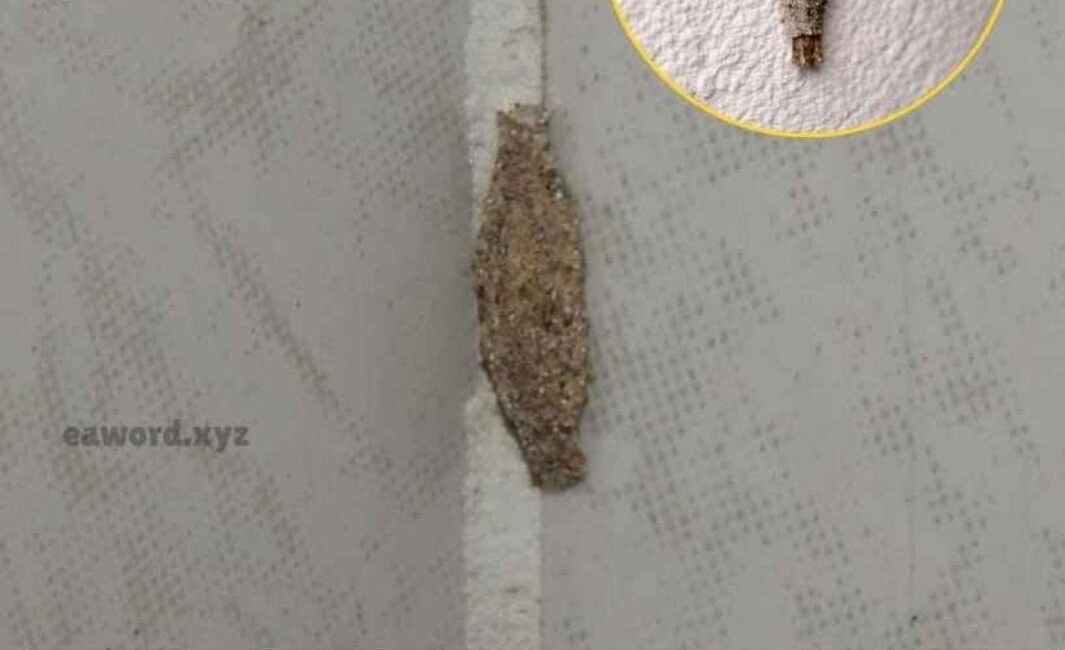
Seeing a tiny case on your wall may feel unsettling at first.
But knowledge changes the reaction.
Instead of panic, think:
It’s a slow-moving larva carrying its silk house.
Not an infestation.
Not a threat.
Just biology intersecting with indoor living.
📌 Final Thoughts
Those small, dust-like capsules on your wall belong to one of the most quietly ingenious insects in household ecosystems.
The case-bearing moth larva:
Builds its own armor.
Moves slowly.
Feeds discreetly.
Transforms quietly.
They are not dangerous.
They are not aggressive.
They are simply part of the natural world adapting to indoor spaces.
Manage them calmly.
Clean thoroughly.
Store fabrics properly.
And appreciate — at least intellectually — the remarkable survival design hidden in something that once looked like dust.
Sometimes, what seems unsettling at first glance turns out to be one of nature’s smallest architects.