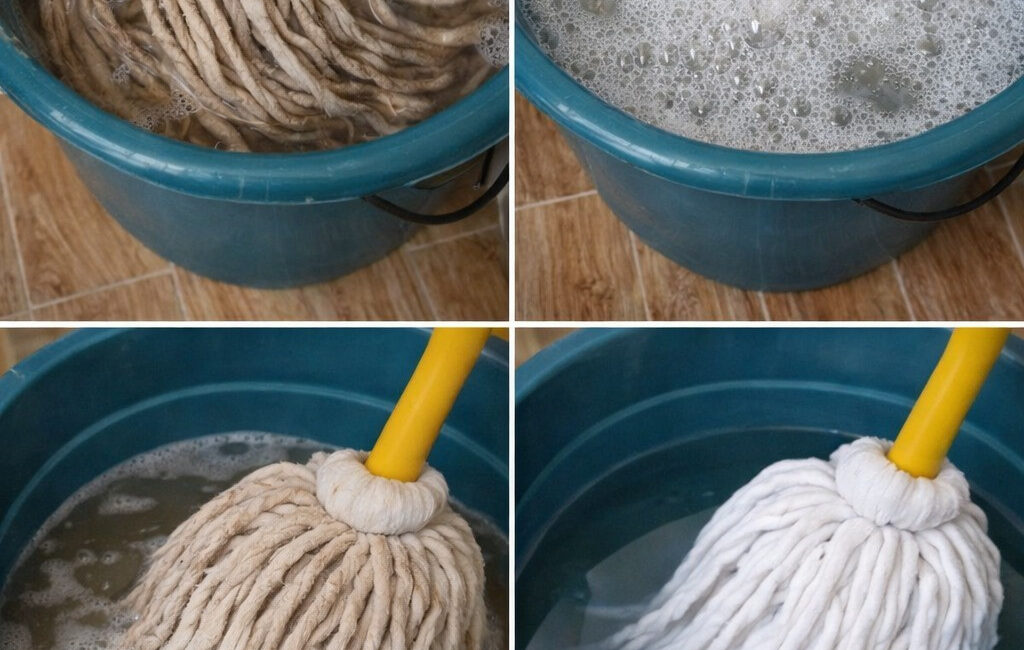
But most mops are discarded due to smell — not structural failure.
Part 14: Preventing the Problem in the Future
Here’s the key:
1. Rinse Immediately After Use
Don’t let dirty water dry into fibers.
2. Use Less Detergent
More soap does not equal cleaner floors.
3. Wring Thoroughly
Less moisture = less bacterial growth.
4. Dry Fully
Never leave in a closed bucket.
5. Deep Clean Monthly
Even if it doesn’t smell yet.
Maintenance beats rescue.
Part 15: The Bigger Lesson About Cleaning Tools
Your mop isn’t dirty because it’s bad.
It’s dirty because it did its job.
Cleaning tools accumulate what they remove.
This applies to:
- Sponges
- Dishcloths
- Towels
- Scrub brushes
They need periodic reset.
Ignoring that leads to unnecessary waste.
Part 16: Why Vinegar Became the “Miracle Drop”
It’s cheap.
It’s accessible.
It’s chemically effective.
It’s safe when diluted.
But it’s not magic.
The magic is:
- Soaking time
- Agitation
- Heat
- Proper drying
The ingredient helps.
The method transforms.
Part 17: When You Actually Should Replace It
Replace the mop if:
- Fibers are thinning drastically
- It leaves lint on floors
- It smells immediately after proper cleaning
- The attachment mechanism is broken
- It no longer absorbs
Otherwise, restoration is often enough.
Part 18: Environmental Impact
Replacing mops frequently:
- Increases textile waste
- Increases plastic waste
- Costs more over time
Cleaning properly extends lifespan.
Small habits reduce consumption.
Household sustainability often starts with maintenance.
Part 19: The Science of Odor Removal
Odor comes from volatile organic compounds (VOCs) released by bacteria.
Vinegar reduces odor by:
- Altering pH
- Disrupting bacterial environment
- Dissolving residue that traps odor molecules
Peroxide reduces odor by:
- Oxidizing organic material
Heat reduces odor by:
- Loosening embedded compounds
Drying prevents odor by:
- Eliminating bacterial growth conditions
Cleaning is chemistry plus physics.
Part 20: Final Thoughts — The Mop as a Metaphor
It’s interesting.
We’re quick to discard what seems dirty.
But often, the problem isn’t damage.
It’s buildup.
With:
- The right method
- The right chemistry
- The right patience
Things can be restored.
Your mop included.
Next time it smells unpleasant, don’t rush to throw it away.
Pause.
Soak it.
Clean it properly.
Dry it completely.
That “one drop” isn’t a miracle.
But understanding why it works?
That’s the real power.
And once you understand the science behind cleaning something as simple as a mop, you start seeing everyday problems differently.
Not as trash.
But as solvable systems.