The Science, Strategy, and Simple Chemistry Behind Making It “As Good As New” Again
There is something uniquely frustrating about a dirty mop.
It’s supposed to clean your floors.
Instead, it starts to smell strange.
It looks gray instead of white.
It leaves streaks instead of shine.
And then comes the thought:
“This mop is disgusting. I should just throw it away.”
But here’s the surprising truth:
Most mops are not ruined.
They’re just contaminated — and poorly cleaned.
And yes, sometimes a single ingredient — used correctly — can dramatically restore them.
Not magic.
Not a marketing trick.
Just chemistry.
Let’s break this down thoroughly — because what seems like a simple household annoyance actually reveals fascinating things about bacteria, fibers, detergent residue, and the science of cleaning.
This will be detailed, practical, and eye-opening.
Part 1: Why Mops Get So Dirty (It’s Not Just Dirt)
When you mop a floor, you’re not just picking up visible debris.
You’re collecting:
- Skin cells
- Grease residue
- Food particles
- Soap buildup
- Pet hair
- Microorganisms
- Mold spores
- Bacteria
- Body oils
- Environmental dust
And here’s the key:
A mop is basically a sponge on a stick.
Sponges trap moisture.
Moisture plus organic material equals microbial growth.
That’s where the smell comes from.
Not dirt.
Bacteria.
Part 2: The Real Problem — Biofilm
Most people rinse their mop under water and assume it’s clean.
It’s not.
Over time, bacteria create something called biofilm.
Biofilm is a sticky protective layer that:
- Shields bacteria from water
- Resists mild soap
- Traps grime inside fibers
- Makes odors persistent
This is the same phenomenon that creates:
- Slime in drains
- Plaque on teeth
- Odor in sponges
Once biofilm forms, simple rinsing won’t fix it.
You need something that breaks it down chemically.
Part 3: Why Throwing It Away Isn’t Always Necessary
Many people replace mops too soon.
Unless the fibers are:
- Torn
- Completely flattened
- Structurally broken
- Falling apart
The mop is probably salvageable.
The issue is contamination, not material failure.
Cleaning tools need cleaning too.
This is the paradox most people overlook.
Part 4: The “One Drop” Ingredient — What Actually Works?
The dramatic phrase “a drop of this ingredient” sounds like a secret hack.
But realistically, the most effective ingredients for restoring a mop are:
- White vinegar
- Hydrogen peroxide
- Baking soda (as support)
- Dish detergent (degreasing agent)
- Bleach (in certain cases)
Among these, the most versatile and safe for most mop types is:
White Vinegar
Why?
Because vinegar:
- Dissolves mineral buildup
- Breaks down biofilm
- Neutralizes odors
- Disrupts bacterial cell walls
- Cuts through soap residue
It’s mildly acidic (acetic acid).
That acidity is powerful against buildup — but gentle on fibers when diluted.
Part 5: The Chemistry Behind Vinegar
Vinegar works because many residues are alkaline.
Soap scum and detergent buildup often leave basic (alkaline) residues.
Acid neutralizes base.
When vinegar meets soap residue:
It breaks it apart.
When vinegar meets odor-causing bacteria:
It alters their environment, making survival difficult.
It does not “kill everything” like bleach.
But it destabilizes what’s making the mop gross.
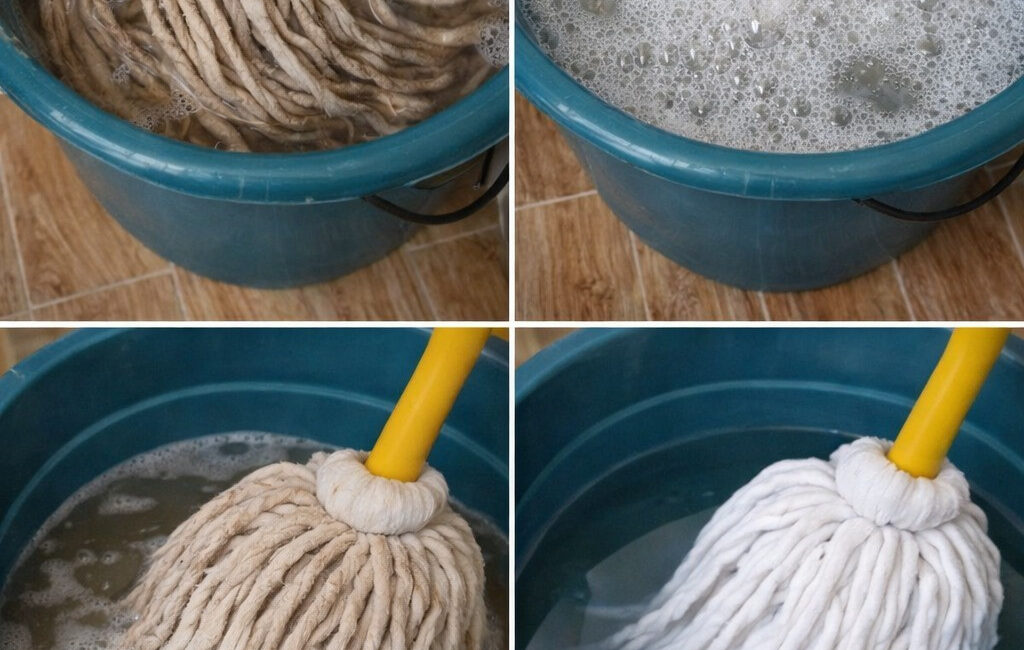
Part 6: The Proper Restoration Method (Step-by-Step)
Let’s do this correctly.
Because technique matters more than ingredient hype.
Step 1: Shake Out Debris
Remove loose dirt and hair manually.
Step 2: Rinse With Hot Water
Use the hottest water your mop can tolerate.
Heat loosens grease and softens biofilm.
Step 3: Prepare a Deep-Clean Soak
Mix:
- 1 liter hot water
- 1 cup white vinegar
- A few drops of dish soap
Soak the mop for 30–60 minutes.
Do not just “drop” vinegar on it.
Soaking allows penetration into fibers.
Step 4: Agitate
Squeeze and massage the mop fibers.
You’ll likely see gray water.
That’s residue leaving.
Step 5: Rinse Thoroughly
Rinse until no vinegar smell remains.
Step 6: Dry Completely
Air-dry in sunlight if possible.
UV light naturally reduces microbes.
Moist storage is what causes future odor.
Part 7: When Vinegar Isn’t Enough
If the mop smells strongly sour or moldy, you may need:
Hydrogen Peroxide (3%)
Hydrogen peroxide:
- Releases oxygen
- Breaks down organic stains
- Kills many odor-causing bacteria
Use it diluted in warm water.
Never mix vinegar and peroxide together directly.
That creates peracetic acid — too harsh.
Use separately.
Part 8: When Bleach Is Appropriate
Bleach is powerful.
But it:
- Degrades natural fibers over time
- Weakens cotton
- Damages microfiber if overused
Use diluted bleach only if:
- The mop has visible mold
- The mop was used for contaminated spills
- You need disinfection (not just deodorizing)
And always rinse extremely well.
Part 9: Why Mops Smell Even After Washing
Here’s a truth most people don’t realize:
Mops often smell because they were never fully dried.
Moisture trapped inside fibers creates:
- Anaerobic bacteria growth
- Sour smell
- Mold spores
The fix is not stronger chemicals.
The fix is complete drying.
Hang it.
Spread the fibers.
Expose to airflow.
Storage matters as much as washing.
Part 10: Microfiber vs Cotton — Why It Matters
Different materials trap dirt differently.
Cotton Mop
- Absorbs deeply
- Harder to rinse fully
- More prone to mildew
Microfiber Mop
- Uses electrostatic attraction
- Holds particles in surface fibers
- Easier to clean properly
Microfiber benefits more quickly from vinegar restoration.
Cotton may require longer soaking.
Part 11: Why Most People Clean Mops Incorrectly
Common mistakes:
- Rinsing with cold water only
- Adding more floor cleaner to the rinse bucket
- Storing mop head damp in a bucket
- Never deep soaking
- Using too much detergent
Excess detergent buildup makes fibers sticky.
Sticky fibers trap more dirt.
More dirt equals more bacteria.
More bacteria equals odor.
Cycle continues.
Part 12: The Psychology of Throwing Things Away
Why do we want to replace it instead of cleaning it?
Because:
- Smell triggers disgust
- Disgust triggers avoidance
- Avoidance triggers disposal
But restoration feels satisfying.
There is a psychological reward in turning “gross” into “clean again.”
It reinforces control over environment.
Part 13: Can a Mop Ever Be Truly “Like New”?
Honest answer:
Sometimes yes.
Sometimes almost.
If fibers are intact, elasticity remains.
If structure is compromised, cleaning helps but won’t restore fiber strength.
Cleaning removes contamination.
It doesn’t reverse fiber wear.
Click page 2 to continue