That’s why so many still function decades later.
Part IX: The Psychology of Tool Nostalgia
When people find vintage kitchen tools, something emotional happens.
They represent:
- A slower era
- Craftsmanship
- Longevity
- Domestic tradition
- Family kitchens
Your memory of seeing one in your grandmother’s drawer isn’t accidental.
These tools were daily-use objects.
They were touched often.
And that repeated use embeds memory.
That’s why vintage kitchen objects feel meaningful.
Part X: The Practical Experience of Using It
Using a vintage aluminum cheese slicer feels different.
You:
- Position the cheese block
- Align the wire
- Apply steady pressure
- Pull smoothly
The resistance is controlled.
The slice falls cleanly.
There’s a mechanical satisfaction to it.
It’s quiet.
Manual.
Precise.
No electricity.
No motors.
No packaging waste.
Just physics.
Part XI: Why It Confused the Internet
The internet thrives on novelty.
When something doesn’t match modern expectation, it becomes:
- Mysterious
- Viral
- Misidentified
People guessed wildly because:
- Few own one today
- Fewer grew up using one
- The design is exposed and minimalist
It lacks obvious labeling.
It looks too simple.
And we’ve become suspicious of simplicity.
Part XII: The Broader Lesson About Object Recognition
When we can’t identify an object, it reveals something interesting:
We assume technology moves forward.
But sometimes, it just changes direction.
The Presto slicer is not primitive.
It’s efficient.
It solved a real need elegantly.
Modern replacements aren’t necessarily superior.
They’re just different.
Part XIII: Cleaning and Maintenance — Why It Survived Decades
Aluminum doesn’t rust.
The wire can be replaced.
There are no gears to fail.
No motors to burn out.
No electronics to short.
That simplicity is longevity.
After slicing:
- Rinse
- Dry
- Store
It’s still usable 70+ years later.
That’s not nostalgia.
That’s engineering.
Part XIV: The Craftsmanship Philosophy of the Mid-20th Century
Mid-century kitchen design valued:
- Mechanical transparency
- Repairability
- Durability
- Multi-generational use
Tools were investments.
Not consumables.
The Presto slicer represents that philosophy.
It wasn’t designed for planned obsolescence.
It was designed to outlive trends.
Part XV: Why Objects Like This Fascinate Us Now
We live in a disposable age.
So when we find something:
- Solid
- Heavy
- Simple
- Functional
It feels rare.
We are drawn to permanence in a temporary world.
That’s why vintage kitchen tools trend online.
They symbolize stability.
Part XVI: Could You Still Use It Today?
Absolutely.
It still slices:
- Cheddar
- Swiss
- Gouda
- Gruyère
- Firm mozzarella
Even modern artisan cheese blocks.
Its function hasn’t changed.
Cheese still behaves the same way.
Physics hasn’t evolved.
Part XVII: Why It’s More Than a Cheese Slicer
It represents:
- Industrial transition after WWII
- Aluminum manufacturing growth
- Domestic design evolution
- Shift from manual to convenience culture
It’s a small object with big historical roots.
Part XVIII: Why the Internet Collaboration Failed
Crowdsourcing works best when:
- Context is clear
- Object is common
- Function is obvious
But niche vintage tools fall through recognition gaps.
Too old for common memory.
Too modern to look antique.
That in-between category creates mystery.
Part XIX: The Quiet Beauty of Functional Design
Look at it closely:
- Clean lines
- Proportional frame
- Mechanical clarity
- No unnecessary decoration
It’s almost architectural.
Minimalism before minimalism was trendy.
Design was about efficiency.
Not branding.
Part XX: Final Thoughts — The Mystery Was Never About the Object
The mystery wasn’t:
“What is this?”
The deeper question was:
“Why don’t we recognize this anymore?”
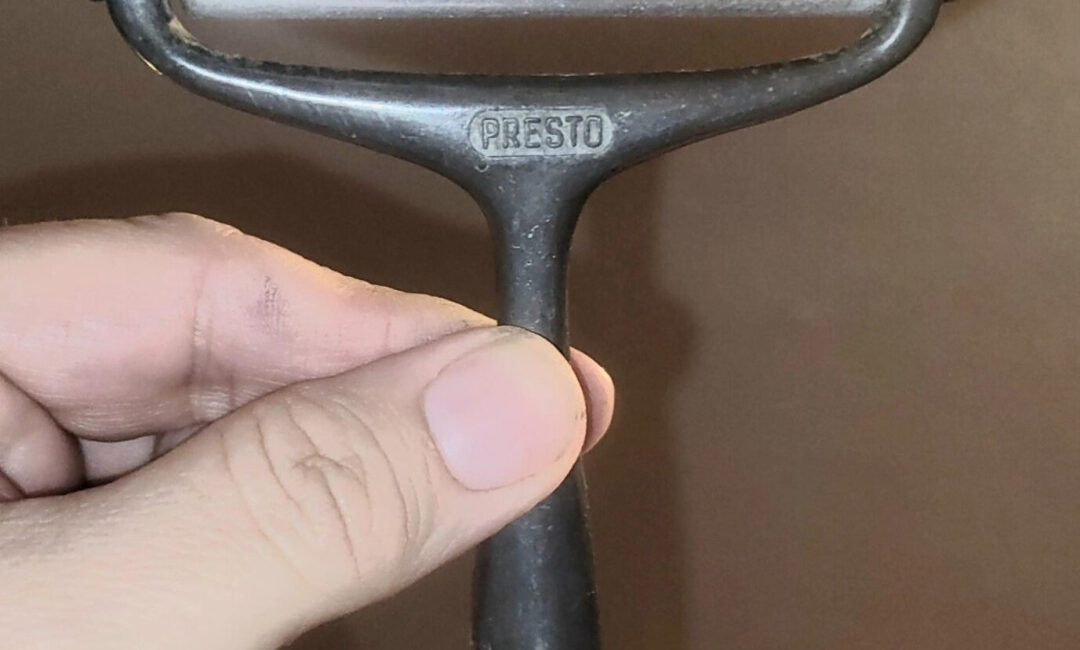
The Vintage Presto Aluminum Cheese Slicer isn’t obscure.
It’s forgotten.
And when we rediscover objects like this, we rediscover something else too:
That simplicity can be brilliant.
That durability can outlast fashion.
That function can be elegant.
And that sometimes, when the whole internet can’t identify something…
It’s not because the object is strange.
It’s because our habits changed.
The slicer didn’t disappear.
We just stopped needing it the same way.
But if you ever pick one up, load a block of cheddar, and pull that wire through —
You’ll understand immediately.
Not mysterious.
Not complicated.
Just well-designed.
And sometimes, that’s enough.