The Full Story Behind the Vintage Presto Aluminum Cheese Slicer — History, Design, Engineering, and Why It Confused 90% of People
There is something uniquely powerful about a mysterious kitchen object.
You find it in a drawer.
Or at a flea market.
Or in your grandmother’s cabinet.
It looks simple.
Solid.
Heavy.
Clearly designed with intention.
And yet…
No one immediately knows what it is.
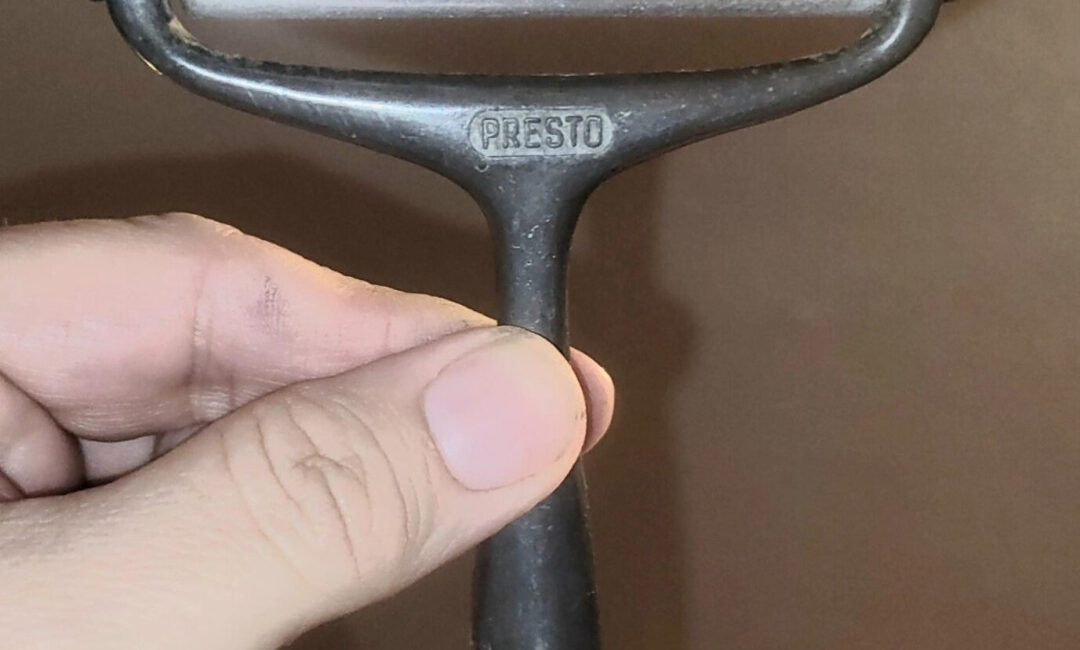
That confusion is what makes the Vintage Presto Aluminum Cheese Slicer so fascinating.
Because on the surface, it looks like:
- A strange aluminum frame
- A handle attached to a flat base
- A thin wire stretched across
- Possibly adjustable components
It doesn’t scream “cheese slicer” to modern eyes.
And that’s exactly why the internet struggled.
Let’s go far deeper than a surface-level explanation.
We’re going to explore:
- Its historical context
- Its engineering design
- Why it confused people
- How it actually works
- Why tools like this disappeared
- And what it tells us about mid-century kitchen philosophy
This isn’t just about slicing cheese.
It’s about how design evolves.
Part I: Why 90% of People Didn’t Recognize It
Modern kitchens have trained our brains differently.
Today, cheese slicing happens through:
- Pre-sliced packages
- Plastic cheese planes
- Box graters
- Electric slicers
- Deli counters
So when someone sees a solid aluminum frame with a taut wire, their brain doesn’t connect it to cheese.
Instead, people guess:
- Butter cutter
- Soap slicer
- Wire tension tool
- Pastry device
- Unknown industrial gadget
The reason for confusion is simple:
We lost familiarity with manual slicing tools.
And once familiarity disappears, recognition follows.
Part II: The Historical Context — 1940s and 1950s Kitchen Engineering
To understand the Presto aluminum cheese slicer, we need to step into post-war America.
The 1940s and 1950s kitchen was:
- Mechanically simple
- Built for durability
- Designed for repeatable precision
- Focused on tool longevity
Aluminum was prized because it was:
- Lightweight
- Rust-resistant
- Affordable
- Easy to cast into durable shapes
Companies like Presto designed kitchen tools meant to last decades — not years.
This slicer wasn’t disposable.
It was engineered.
Part III: Why Aluminum?
Aluminum became extremely popular after WWII.
Why?
Because wartime production had advanced aluminum manufacturing dramatically.
Factories that once produced aircraft components transitioned into consumer goods.
That’s why so many mid-century kitchen gadgets are aluminum.
The Presto slicer reflects that era:
- Solid cast aluminum frame
- Minimal moving parts
- Clean industrial lines
- Practical over decorative
It wasn’t designed to look cute.
It was designed to function.
Part IV: The Engineering Behind the Wire
The thin wire is the secret.
Why not a blade?
Because cheese behaves differently from other foods.
Cheese is:
- Dense
- Slightly elastic
- Sticky
- Compressible
A blade pushes and compresses cheese.
A wire slices cleanly through it with less friction.
That’s the same reason modern cheese slicers still use wire.
The tensioned wire:
- Reduces sticking
- Creates even slices
- Requires less pressure
- Preserves structural integrity
It’s simple physics.
Less surface area touching cheese = cleaner cut.
Part V: Why It Looks “Strange” Today
Modern tools hide their mechanics.
Vintage tools show them.
The Presto slicer exposes:
- The tension wire
- The frame
- The slicing path
Nothing is concealed.
That openness makes it look unfamiliar to people used to plastic, enclosed designs.
It feels industrial.
Almost like a workshop tool.
But that transparency was once considered quality craftsmanship.
Part VI: The Adjustable Thickness Feature
Many versions of this slicer included adjustable wire height.
That meant you could control slice thickness.
Thick slices for:
- Sandwiches
- Melting
- Cooking
Thin slices for:
- Platters
- Garnishing
- Controlled portioning
This was important in an era when:
- Cheese was bought in blocks
- Pre-sliced packaging didn’t exist
- Food waste mattered more
- Portion control meant budgeting
It wasn’t luxury.
It was practicality.
Part VII: The Cultural Shift That Made It Obsolete
Why did tools like this fade away?
Three reasons:
1. Industrial Food Packaging
Pre-sliced cheese became cheap and widespread.
2. Plastic Manufacturing
Plastic tools were cheaper to produce.
3. Convenience Culture
Speed replaced precision.
When people stopped buying cheese in large blocks, manual slicers became less common.
Not because they stopped working.
But because habits changed.
Part VIII: Why It Feels So Durable
Pick one up and you’ll notice:
It’s heavy.
Solid.
Cold.
That’s because it was cast metal — not stamped thin sheet.
The frame absorbs force.
The wire remains stable.
It doesn’t flex.
Modern plastic slicers:
- Bend
- Warp
- Break
The Presto slicer was overbuilt.
Click page 2 to continue