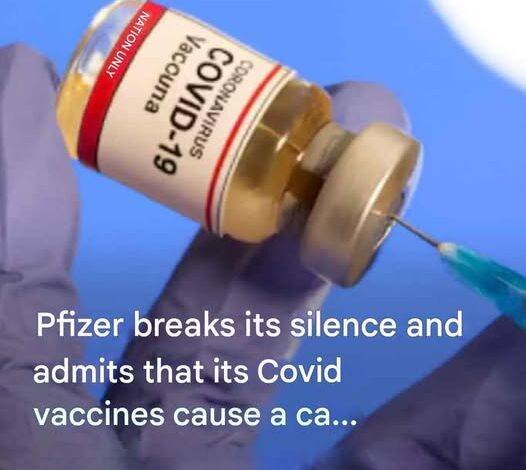
Few topics in modern medicine have generated as much debate, confusion, and emotional intensity as COVID-19 vaccines. Headlines often circulate claiming that a pharmaceutical company has “admitted” that its vaccine causes a particular condition. These statements spread quickly, sometimes without context, nuance, or explanation of what was truly said.
When a claim appears that “Pfizer admits its COVID vaccine causes this,” the first responsibility is not to react — but to clarify.
What exactly was acknowledged?
What does the data show?
What is the difference between a known rare side effect and a widespread hidden danger?
And how do regulatory agencies communicate risk?
This article takes a detailed, evidence-based approach to explain what has actually been recognized regarding COVID-19 vaccine side effects, how safety monitoring works, and why nuance matters in public health discussions.
Understanding How Vaccine Safety Monitoring Works
Before discussing any specific condition, it is crucial to understand how vaccine safety systems operate.
Vaccines go through multiple phases of clinical trials before approval:
- Preclinical laboratory testing
- Phase 1 trials (small groups for safety)
- Phase 2 trials (dose and immune response)
- Phase 3 trials (tens of thousands for efficacy and safety)
However, even large trials cannot detect extremely rare side effects. That is why post-authorization safety monitoring continues after vaccines are released to the public.
In the United States, systems such as:
- VAERS (Vaccine Adverse Event Reporting System)
- V-safe
- CDC monitoring programs
- FDA surveillance
collect and analyze reports of adverse events.
Globally, agencies like:
- The European Medicines Agency (EMA)
- The World Health Organization (WHO)
- National pharmacovigilance systems
conduct similar reviews.
When patterns emerge, investigations begin.
Sometimes that leads to updated guidance.
Sometimes it leads to labeling changes.
Sometimes it confirms no causal link.
This process is not an “admission of guilt.” It is standard pharmacovigilance — the continuous monitoring of any medical product.
The Most Discussed Condition: Myocarditis
One condition widely discussed in relation to mRNA COVID-19 vaccines (including Pfizer’s) is myocarditis.
What Is Myocarditis?
Myocarditis is inflammation of the heart muscle.
Symptoms may include:
- Chest pain
- Shortness of breath
- Fatigue
- Palpitations
Most reported vaccine-associated cases have occurred in:
- Young males
- Typically within a few days after the second dose
Most cases have been mild and resolved with treatment and rest.
What Has Been Officially Acknowledged?
Regulatory agencies have acknowledged that myocarditis and pericarditis (inflammation of the heart lining) are rare potential side effects of mRNA vaccines.
This acknowledgment is publicly documented in:
- FDA safety updates
- CDC guidance
- European Medicines Agency communications
It is not a hidden revelation. It has been openly discussed since 2021.
The risk has been described as:
Rare.
Estimates vary by age and gender, but approximate rates for young males have been reported in the range of tens of cases per million doses.
To provide context:
COVID-19 infection itself carries a significantly higher risk of myocarditis than vaccination.
Risk Comparison: Vaccine vs. Infection
Multiple large-scale studies have found that:
- Myocarditis risk after COVID infection is higher than after vaccination.
- Infection-related myocarditis can be more severe.
When evaluating medical risk, it is not simply about whether a side effect exists.
It is about comparative risk.
For public health decisions, authorities evaluate:
- Risk of vaccine side effect
- Risk of infection complication
- Population-level outcomes
This risk-benefit analysis is central to vaccine policy.
Other Reported Side Effects
Like all medical products, COVID-19 vaccines have side effects.
Common ones include:
- Injection site pain
- Fatigue
- Headache
- Muscle aches
- Fever
These are expected immune responses.
Rare adverse events that have been studied include:
- Anaphylaxis (severe allergic reaction)
- Myocarditis/pericarditis
- Very rare clotting events (more associated with non-mRNA vaccines)
Each of these has been openly investigated and described in official documentation.
What Does “Admits” Actually Mean?
When people say “Pfizer admits,” they often refer to:
- Public testimony
- Regulatory filings
- Updated safety labels
- Scientific publications
However, acknowledgment of rare side effects is not equivalent to concealment or scandal.
All pharmaceutical companies update product information when new data emerges.
This is standard for:
- Blood pressure medications
- Antibiotics
- Cancer drugs
- Pain relievers
Medical transparency includes documenting rare risks.
That is how science evolves.
Why Confusion Happens
There are several reasons why vaccine discussions become polarized.
1. Emotional Impact
The pandemic involved fear, uncertainty, and global disruption.
Emotions amplify interpretation of information.
2. Social Media Amplification
Short, dramatic statements spread faster than nuanced explanations.
A headline like:
Click page 2 to continue