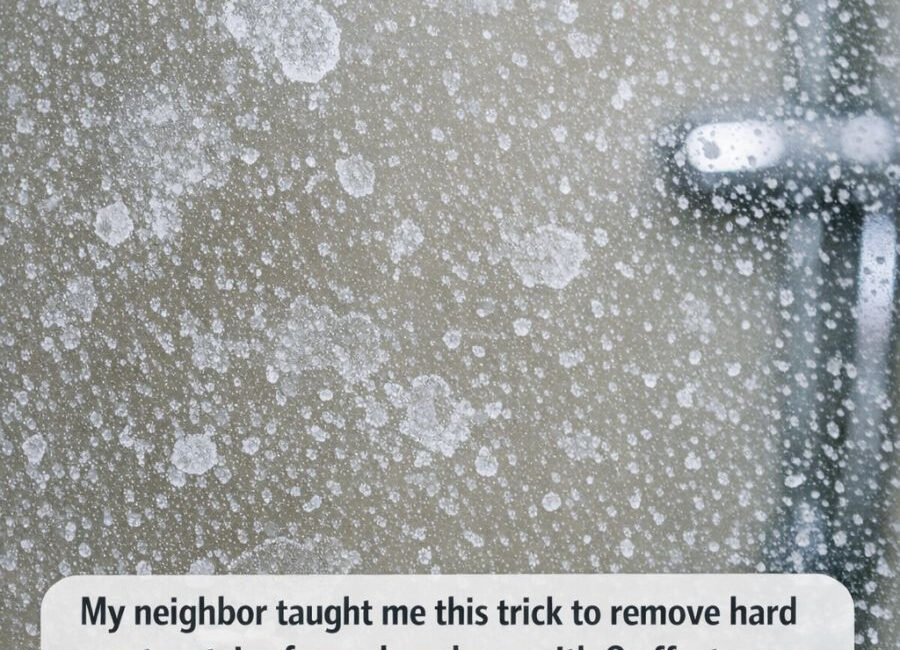
If you’ve ever looked at your shower glass door and thought, “Was this always this cloudy?” — you’re not alone.
Hard water stains sneak up quietly. One day your glass sparkles. A few months later, it looks frosted. No matter how much you wipe, those chalky streaks refuse to disappear.
Then one afternoon, my neighbor casually said:
“You’re scrubbing too much. You don’t need effort. You need chemistry.”
He walked over with one simple household item.
And within minutes, the glass looked almost new.
Here’s the trick — and the science behind why it works.
First: What Hard Water Stains Actually Are
Hard water stains aren’t dirt.
They’re mineral deposits.
When water evaporates, it leaves behind dissolved minerals like:
- Calcium
- Magnesium
- Lime
Over time, these minerals build up and bond to the glass surface.
That cloudy film you see?
It’s basically microscopic rock.
That’s why regular soap and water don’t work well. Soap removes grease. Hard water stains are mineral-based.
Different problem. Different solution.
The “Zero-Effort” Trick: White Vinegar
That’s it.
Plain white vinegar.
My neighbor’s method was simple:
- Warm a small amount of white vinegar (not boiling — just warm).
- Spray it generously onto the glass.
- Let it sit for 5–10 minutes.
- Wipe with a microfiber cloth.
- Rinse and dry.
No scrubbing. No expensive cleaners.
Just patience.
Why Vinegar Works (The Science)
Vinegar contains acetic acid.
Hard water stains are alkaline mineral deposits.
When acid meets alkaline minerals, a chemical reaction occurs.
The acid dissolves the calcium and magnesium buildup, breaking it down so it can be wiped away easily.
It’s not magic.
It’s basic chemistry.
The warmth helps because higher temperature increases reaction speed.
Warm vinegar penetrates deposits faster.
Why “Zero Effort” Is Mostly True
The key is not force.
It’s dwell time.
Most people spray and immediately scrub.
That forces you to work harder.
Letting vinegar sit allows the acid to do the work.
You’re not scrubbing minerals off.
You’re dissolving them.
Huge difference.
What If the Stains Are Very Old?
For heavy buildup, my neighbor had a second trick.
He soaked paper towels in vinegar and pressed them directly onto the glass.
This keeps the surface saturated longer.
Leave it for 20–30 minutes.
Then wipe.
The towel prevents evaporation and gives the acid time to penetrate thick deposits.
Still minimal effort.
Just more time.
Bonus Upgrade: Vinegar + Baking Soda (Used Correctly)
Important note:
Don’t mix vinegar and baking soda in a container — they neutralize each other immediately.
But you can:
- Apply baking soda lightly to the glass.
- Spray vinegar on top.
This creates a mild fizzing action that helps loosen stubborn areas.
Again — let it sit.
Then wipe.
What NOT to Do
Many people damage their glass by using:
- Steel wool
- Razor blades (unless professionally done)
- Harsh abrasive powders
- Rough scrub pads
Click page 2 to continue