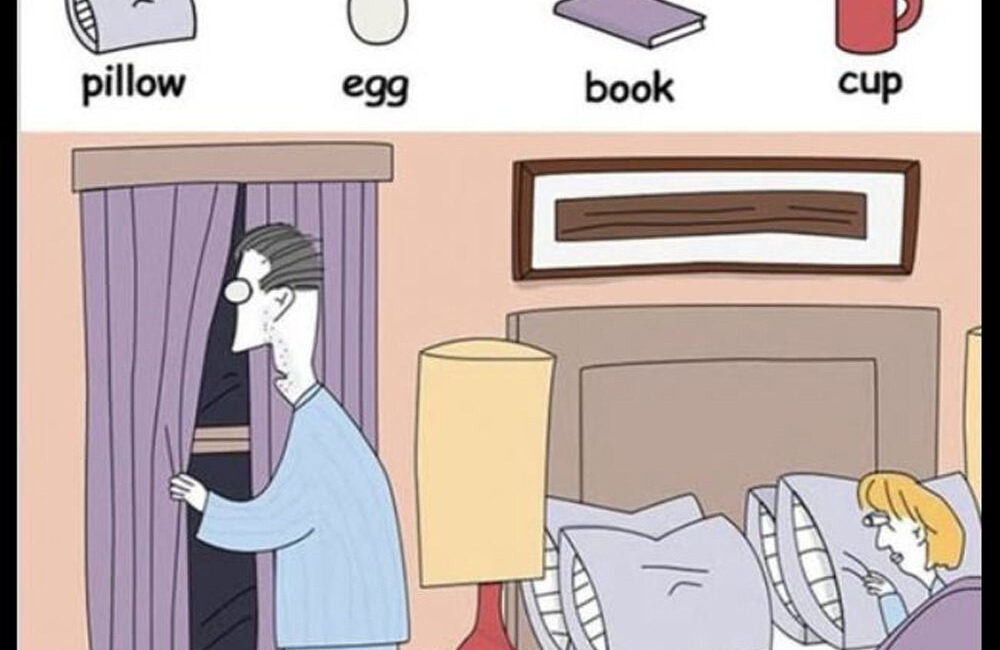
A pillow in a bedroom seems obvious.
But what if:
- A second pillow is hidden within the headboard pattern?
- A shadow forms a pillow-like shape?
- The bedding folds create an illusion of duplication?
The trick with the pillow is scale confusion.
It may not be a “real” pillow sitting on the bed.
It may be a silhouette formed by surrounding shapes.
Look for repeating curves.
Pillows are soft rectangles with rounded edges.
Find that geometry.
Why Once You See It, You Can’t Unsee It
There’s a fascinating cognitive phenomenon called perceptual learning.
Once your brain identifies a hidden object, it strengthens the neural pathway associated with that pattern.
That’s why:
- The object becomes obvious afterward.
- You wonder how you ever missed it.
- The illusion loses its power.
Your brain updates its internal model of the image.
It permanently changes how you perceive it.
What This Puzzle Teaches You About Real Life
Hidden object puzzles are more than games.
They demonstrate how:
- We overlook what blends in.
- Familiar environments hide anomalies.
- Assumptions limit perception.
- Focus changes outcomes.
In everyday life, the same principle applies.
We often see what we expect to see.
And miss what we don’t expect.
The Emotional Side of Puzzles
There’s a small rush when you find the first object.
A micro “aha” moment.
That rush releases dopamine—the brain’s reward chemical.
Which is why puzzles feel addictive.
They challenge and reward simultaneously.
And the ticking mental clock (17 seconds!) increases the thrill.
If You Haven’t Found Them Yet
Slow down.
Forget the timer.
Scan the edges.
Corners are powerful hiding spots.
Dark areas conceal outlines.
Clutter disguises shape.
Shift from color-based searching to geometry-based searching.
Look for:
- Perfect ovals
- Clean rectangles
- Repeating curved forms
- Unnatural symmetry
The objects are not floating randomly.
They are integrated deliberately.
Final Reflection
The bedroom scene looks ordinary.
But ordinary is exactly what makes it deceptive.
The book, the cup, the egg, and the pillow are hidden in plain sight.
The challenge isn’t about eyesight.
It’s about perception.
And once you spot even one of them, the image transforms.
You realize something powerful:
You weren’t blind.
You were filtering.
And sometimes, the difference between missing something and discovering it is simply choosing to look more carefully.
So…
How long did it take you?