Hidden object puzzles have fascinated people for generations. They look simple. They feel playful. And yet, they quietly expose how selective—and sometimes unreliable—our perception can be.
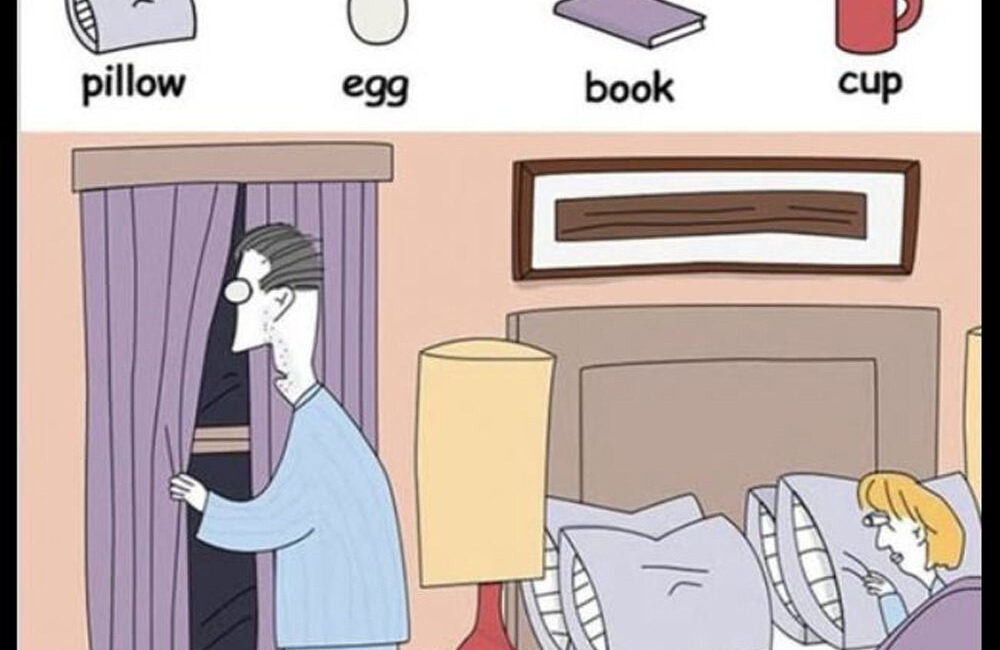
At first glance, everything appears perfectly ordinary.
A bedroom.
Soft lighting from a bedside lamp.
A neatly made bed.
Furniture placed logically.
Nothing alarming. Nothing dramatic.
But here’s the twist:
Somewhere in that calm, familiar scene are four everyday items cleverly concealed:
- A book
- A cup
- An egg
- A pillow
And the challenge is deceptively straightforward:
Find them in 17 seconds.
It sounds easy.
It isn’t.
Why Hidden Object Puzzles Are Harder Than They Look
Your eyes don’t scan randomly.
Your brain actively filters information before you’re even aware of it. This process is called selective attention.
Selective attention helps you ignore irrelevant details in everyday life. It’s why you don’t consciously notice every shadow, texture, or corner of a room you walk into.
But in puzzles like this, that mental efficiency becomes a disadvantage.
Because the hidden objects are disguised to look like they belong.
Your brain sees “bedroom” and automatically categorizes what should be there.
Anything that blends in escapes detection.
The 17-Second Rule
Seventeen seconds is not random.
Short time limits:
- Increase cognitive pressure
- Narrow visual scanning
- Force instinctive pattern recognition
When under time pressure, your brain stops methodically searching and starts guessing.
And that’s exactly where most people fail.
The key is not speed.
The key is strategy.
How to Search Like a Puzzle Pro
Instead of looking for objects, look for:
- Outlines
- Shapes
- Negative space
- Slight inconsistencies
Color can mislead you. Shape rarely does.
Let’s break down how each item might be hidden.
The Book: Camouflage Through Familiarity
A book is one of the easiest objects to hide in plain sight.
Why?
Because books already belong in a bedroom.
The hidden book may:
- Blend into the nightstand surface
- Mimic the texture of furniture
- Be partially merged with shadows
- Disguise itself in wallpaper patterns
Your brain may register it as “background” before you consciously identify it.
To find it, focus on straight edges and rectangular silhouettes.
Books have structure.
Look for structure.
The Cup: Shape Disguised by Light and Shadow
A cup has a very recognizable outline.
But if its handle aligns with a lamp base or blends with decorative curves, your brain might miss it.
Focus on:
- Circular rims
- Symmetry
- Hollow shapes
- Subtle shadows under curved forms
The cup is likely hidden near clutter or overlapping shapes.
It may not be centered.
It may be peripheral.
The Egg: The Trickiest of All
The egg is dangerous in puzzles because it’s simple.
Too simple.
An egg is:
- Oval
- Smooth
- Minimal
Which makes it easy to blend into:
- Bed sheets
- Decorative patterns
- Wall highlights
- Lamp reflections
Your brain may interpret it as light reflection or fabric fold.
To find it, search for symmetry that doesn’t match fabric texture.
Eggs don’t wrinkle.
Fabric does.
The Pillow: Hidden Within Itself
This is where it gets clever.
Click page 2 to continue