Let’s be rational.
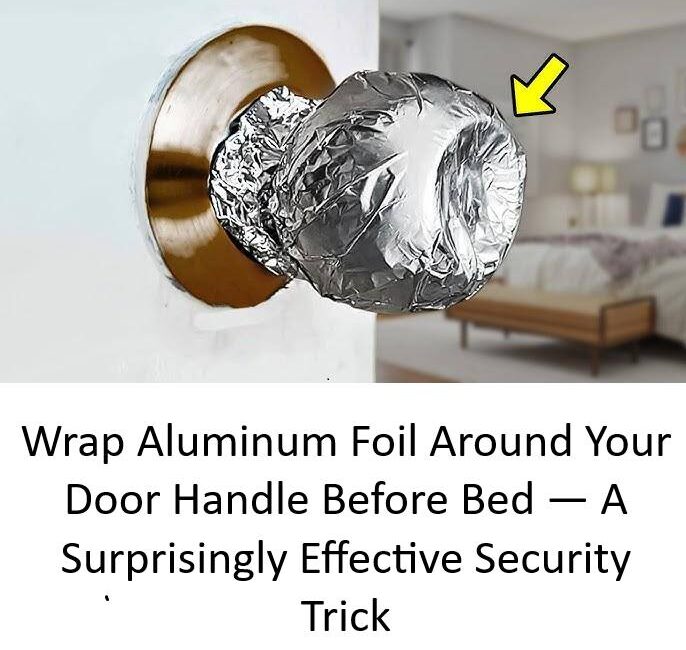
Applying a chemical to someone’s door handle as part of a crime is extremely rare and largely myth-driven.
Most criminals rely on speed and access — not elaborate chemical plots.
Foil does not meaningfully increase safety against such unlikely scenarios.
Why This Trick Spread So Fast
Three reasons:
- It’s cheap.
- It feels clever.
- It plays on fear.
Fear-based advice spreads quickly because it activates survival instincts.
But good security is built on strategy, not symbolism.
A Thought Experiment
Imagine someone attempting forced entry.
Would foil:
- Slow them?
- Stop them?
- Scare them?
Or would it simply tear instantly?
Security must change resistance.
Foil changes appearance.
There’s a difference.
Is It Harmful?
No.
Wrapping foil around your handle won’t damage your door.
At worst, it’s ineffective.
At best, it provides slight psychological comfort.
If it helps you sleep, that has value.
But understand what it does — and what it doesn’t.
The Real Lesson Here
When you see a viral safety trick, ask:
Does this change physics?
Does this increase resistance?
Does this delay entry?
Or does it just look protective?
Security is about layers.
Real layers.
- Physical reinforcement
- Visibility
- Lighting
- Awareness
- Community vigilance
Foil is not a layer. It’s a surface.
Final Thought
If you want to improve your security tonight:
Check your locks.
Tighten loose screws.
Turn on exterior lights.
Lock windows.
Keep keys away from doors.
Use a door wedge if you want added internal resistance.
Those steps change outcomes.
Foil changes optics.
There’s nothing wrong with wanting reassurance.
Just make sure reassurance is backed by reality.
Because the best security isn’t dramatic.
It’s solid, boring, and engineered.
And that’s exactly why it works.