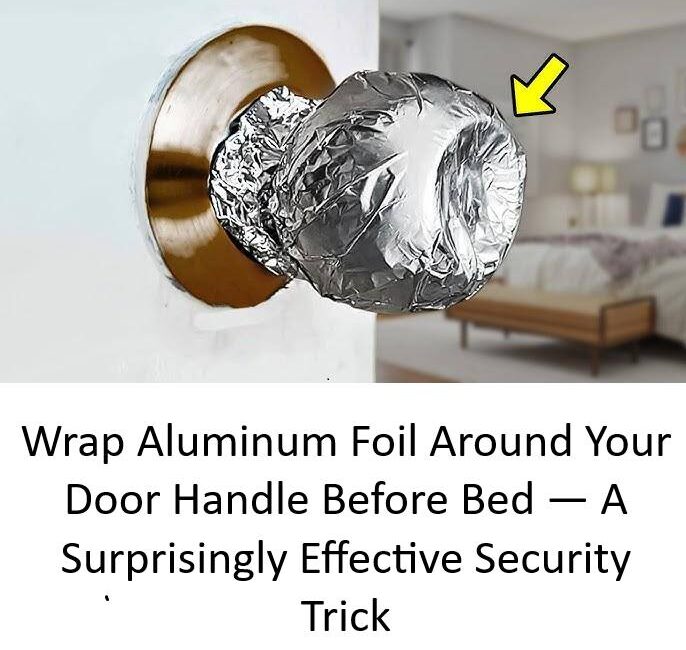
Every so often, a household “hack” sweeps across the internet and makes people pause mid-scroll.
Wrap aluminum foil around your door handle before bed.
It sounds strange. Almost theatrical. Like something from a suspense movie.
The claim? It can improve your home security.
But let’s slow down. Breathe. And think clearly.
Because when it comes to safety, fear spreads faster than facts.
The Claim: What People Say the Foil Does
According to viral posts, wrapping aluminum foil around your door handle supposedly:
- Makes it harder for someone to quietly turn the handle
- Creates noise if someone tries to tamper with it
- Acts as a visual indicator of forced entry
- Prevents chemical substances from being applied to the handle
- Works as a “low-cost security alarm”
It sounds clever. Simple. Accessible.
But the real question is:
Does it actually work?
The Physics of It: What Foil Actually Does
Aluminum foil is thin. Flexible. Soft.
When wrapped around a door handle, it:
- Crinkles easily
- Tears under pressure
- Reflects light
- Conducts heat
It does not:
- Reinforce the lock
- Strengthen the door
- Prevent forced entry
- Replace a deadbolt
So what could it realistically accomplish?
Noise.
If someone tried to slowly turn the handle, the foil might crinkle.
But here’s the catch:
A person intentionally breaking in is unlikely to be deterred by the sound of foil.
A determined intruder can:
- Tear it off instantly
- Ignore the noise
- Use tools instead of touching the handle
Foil is not a structural defense.
The Psychology Behind the Trick
This is where things get interesting.
The trick works less on burglars — and more on our minds.
It provides:
- A sense of action
- A feeling of control
- A visible ritual of “doing something”
Humans dislike uncertainty.
When we feel vulnerable, even symbolic actions reduce anxiety.
Wrapping foil may help someone sleep better.
But emotional comfort and actual security are not the same thing.
When Could It Actually Be Useful?
There are a few niche scenarios where foil might help slightly:
1. Detecting Subtle Tampering
If you live in a shared building and worry about someone testing your handle while you’re asleep, foil could act as a visible disturbance marker.
If it’s ripped or moved in the morning, you’d know someone touched it.
But again — this is detection, not prevention.
2. Temporary Visual Signal
In rare cases, foil could act as a crude indicator if someone tries to manipulate the handle while you’re inside.
But modern door handles already make noise.
Most doors creak, latch-click, or shift when moved.
Foil adds minimal new detection value.
What Actually Improves Door Security
If your goal is real protection, here’s what actually works:
- A solid deadbolt
- Reinforced strike plates
- Longer screws in hinges and lock plates
- A door jamb reinforcement kit
- Motion-activated exterior lighting
- A peephole or camera
- A door sensor alarm
These are mechanical, structural solutions.
They change force dynamics.
Foil does not.
The “Chemical on the Handle” Myth
Some viral posts claim foil protects against substances being applied to your handle — like drugs or harmful chemicals.
Click page 2 to continue