According to Sarah Farmer, Executive Culinary Director at Taste of Home
Air fryers have quietly transformed modern home cooking. They promise crisp food with less oil, faster cooking times, and fewer dishes. But with that convenience comes confusion—especially when it comes to aluminum foil. Some people swear by it. Others insist it ruins food or damages the appliance. Many are afraid to use it at all.
Into this confusion steps Sarah Farmer, executive culinary director at Taste of Home, who has spent years testing home appliances the way real people actually use them—not in lab-perfect conditions, but in everyday kitchens. Her guidance cuts through myths, half-truths, and viral misinformation to explain exactly when foil is helpful, when it’s harmful, and how to use it safely and effectively in an air fryer.
This article dives deep into the science, safety, technique, and practical wisdom behind using foil in an air fryer—grounded in professional culinary experience and real-world testing. If you’ve ever wondered whether foil belongs in your air fryer, this is the complete answer.
Why Foil Became Controversial in Air Fryers
At first glance, the controversy seems strange. Foil has been used safely for decades in ovens, grills, and toaster ovens. Why would an air fryer be any different?
The answer lies in how air fryers work.
Air fryers are not miniature ovens. They are compact convection machines designed to move hot air rapidly and continuously around food. That airflow is not a bonus feature—it is the entire cooking mechanism. Anything that interferes with it can affect cooking performance, texture, and safety.
Foil, when used incorrectly, can block airflow, trap heat unevenly, or even shift during cooking. That’s where the warnings come from. But as Sarah Farmer explains, the problem is not foil itself—it’s misuse.
The Core Principle: Airflow Is Sacred
According to Sarah Farmer, the single most important rule of air fryer cooking is this:
Never block airflow.
Air fryers rely on unobstructed circulation of hot air to:
- Cook food evenly
- Create crisp surfaces
- Prevent hot spots
- Maintain safe operating temperatures
When foil is placed incorrectly—especially covering the bottom of the basket or blocking vents—it disrupts this system. That’s when food cooks unevenly, takes longer, or ends up soggy instead of crisp.
Used properly, however, foil can be a powerful tool.
What Foil Can Do Well in an Air Fryer
Sarah Farmer emphasizes that foil is not an enemy. In fact, it can be extremely useful when used with intention.
1. Contain Messy Foods
Foods that release juices, marinades, or melted fat—such as:
- Marinated chicken
- Glazed salmon
- Sausages
- Cheese-topped dishes
can drip into the air fryer basket and burn, creating smoke and difficult cleanup.
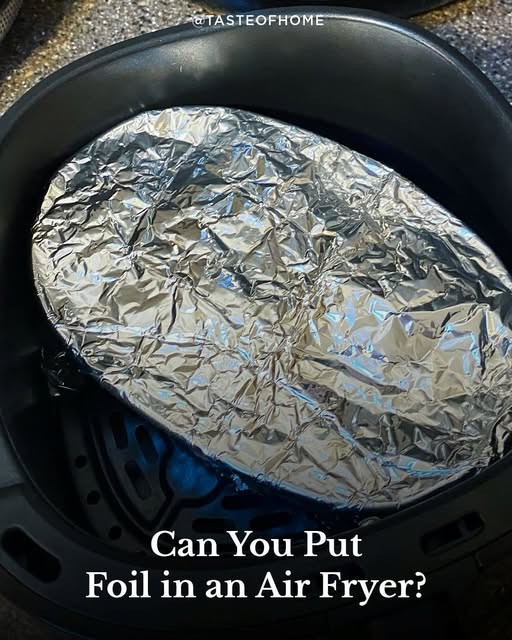
A carefully placed foil liner catches drips without interfering with airflow when used correctly.
2. Protect Delicate Ingredients
Certain foods cook too aggressively in an air fryer’s intense heat.
Foil can:
- Shield delicate fish from direct airflow
- Prevent cheese from flying around
- Protect baked goods from over-browning
The key is partial coverage, not enclosure.
3. Improve Cleanup (But Not Replace Cleaning)
Foil can reduce cleanup, but Sarah Farmer is clear: it is not a substitute for cleaning your air fryer. It simply minimizes baked-on residue when used occasionally and thoughtfully.
What Foil Should Never Do in an Air Fryer
This is where most mistakes happen.
Never Line the Bottom of the Basket
Lining the entire bottom of the air fryer basket with foil is one of the most common—and dangerous—errors.
Why?
- It blocks air intake
- It causes uneven heat buildup
- It can overheat internal components
Sarah Farmer stresses that air fryers are engineered with airflow from below upward. Blocking that pathway undermines the appliance’s design.
Never Use Loose Foil
Loose foil can lift, flutter, or contact the heating element.
This can lead to:
- Burning
- Smoke
- Fire risk
- Damage to the appliance
Foil must always be secured by food.
Never Wrap Food Tightly Unless the Recipe Demands It
Tightly wrapping food in foil defeats the purpose of air frying. Instead of convection cooking, you create a steaming environment.
That’s fine for some dishes—but it will not produce crisp results.
The Right Way to Use Foil, Step by Step
Sarah Farmer’s recommended method is simple but precise.
Step 1: Use Small Pieces Only
Cut foil to fit just under the food, not the basket.
Think of foil as a plate, not a liner.
Step 2: Shape, Don’t Flatten
Gently mold foil to create shallow edges. This keeps juices contained while still allowing air to flow around the food.
Avoid sealing the sides.
Step 3: Anchor Foil with Food
Place food directly on top of the foil so it cannot move.
If foil can shift, it doesn’t belong there.
Step 4: Leave Space Around the Edges
Always leave gaps where air can circulate freely.
This preserves crispness and safety.
Foods That Work Well with Foil in an Air Fryer
Sarah Farmer notes that foil shines in specific situations.
Excellent Candidates
- Marinated meats
- Fish with skin
- Stuffed vegetables
- Cheese-heavy items
- Sticky sauces
Foods Better Without Foil
- French fries
- Breaded foods
- Anything meant to be crispy all around
Foil softens texture where it touches food. That’s a feature or a flaw depending on the dish.
Foil vs Parchment Paper: Not the Same Thing
Many people assume foil and parchment paper are interchangeable. They are not.
Foil:
- Reflects heat
- Conducts heat
- Blocks moisture
Parchment Paper:
- Absorbs some moisture
- Is nonstick
- Allows limited airflow if perforated
Sarah Farmer often recommends perforated parchment paper for foods like fries or chicken wings, where crispness is critical.
Foil is better for containment and protection.
Does Foil Affect Cooking Time?
Yes—slightly.
Foil reflects radiant heat, which can:
- Reduce browning on the underside
- Increase moisture retention
- Require flipping for even cooking
This is not a flaw, but it must be accounted for.
Professional testing shows that foods cooked on foil may need:
- A mid-cook flip
- A final uncovered minute to crisp
Safety Myths About Foil and Air Fryers
Click page 2 to continue