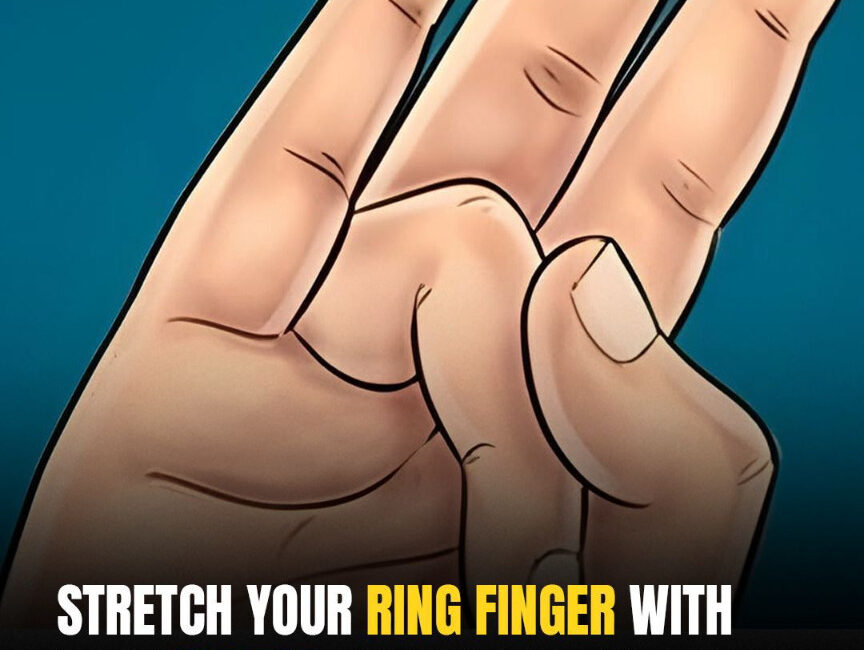
Scroll long enough on social media and you will eventually encounter a familiar promise: a simple gesture, a tiny movement, a few seconds of effort—followed by a dramatic claim that your body or mind will respond in a surprisingly powerful way. One of the most persistent versions of this trend is the instruction to stretch your ring finger with your thumb, hold it for a few seconds, and enjoy the result. The image usually shows a hand, the ring finger gently pulled or pressed, and a caption hinting at relaxation, stress relief, emotional balance, or even internal healing.
At first glance, it looks harmless, almost charming. It requires no equipment, no cost, no expertise. The appeal is obvious: a small action that promises a big payoff. But what is really happening when you stretch your ring finger with your thumb? Is there a genuine physiological or neurological effect, or is this another case of internet mysticism dressed up as wellness advice?
To answer that question properly, we need to step away from hype and examine the anatomy of the hand, the nervous system’s response to touch and movement, the cultural traditions that inspire such claims, and the psychology behind why people feel something when they perform these gestures. The truth is neither magical nor meaningless. It sits in a fascinating middle ground where biology, perception, and belief intersect.
Why the Ring Finger Gets Special Attention
The ring finger has always occupied a curious place in human culture. It is not the strongest finger, nor the most dexterous. The index finger points. The thumb grips. The little finger stabilizes. The ring finger, however, is associated with symbolism rather than function. In many cultures, it is linked to commitment, emotion, and connection. This symbolic weight primes people to believe that manipulating the ring finger may influence emotional or internal states.
From an anatomical perspective, the ring finger shares tendons and nerve pathways with neighboring fingers more than people realize. It does not operate in isolation. Its movement is closely coordinated with the middle and little fingers, which is why it often feels less independent. When you stretch the ring finger using the thumb, you are not just moving one digit—you are engaging a small network of muscles, tendons, and sensory nerves that report directly to the brain.
That sensory input is where the real story begins.
What Actually Happens When You Stretch a Finger
When you stretch your ring finger with your thumb, several things occur simultaneously. Muscles lengthen slightly, tendons glide within their sheaths, and pressure receptors in the skin and joints activate. These receptors send signals to the brain through peripheral nerves. The brain interprets these signals not just as mechanical information, but as part of a broader sensory experience.
The human nervous system is deeply responsive to slow, deliberate movement. Unlike sudden or forceful motion, gentle stretching activates parasympathetic pathways—the part of the nervous system associated with calm, regulation, and recovery. This is why stretching, breathing exercises, and slow movements often feel soothing.
In other words, the sensation you may feel is not specific to the ring finger. It is a general response to controlled touch and focused movement.
The Role of Attention and Awareness
One crucial factor rarely mentioned in viral captions is attention. When you stretch your ring finger and hold it, you are doing something unusual. You stop scrolling. You focus on your hand. You feel the pressure. You wait.
This moment of attention is powerful. Modern life is dominated by fragmented focus. A few seconds of concentrated awareness can feel disproportionately calming simply because it interrupts mental noise. The brain interprets this pause as a form of regulation.
This is not placebo in the dismissive sense. Attention genuinely alters neural activity. Brain imaging studies consistently show that focused awareness reduces activity in stress-related regions and increases coherence in networks associated with body awareness.
The finger stretch becomes a physical anchor for attention, much like holding a smooth stone or pressing your feet into the ground.
Why People Report Immediate Relief
Many people report that stretching the ring finger produces a sense of release, relaxation, or emotional softening. This experience is real, but its source is often misunderstood.
The hand is densely innervated. It contains a high concentration of sensory receptors compared to many other body parts. This makes it an effective gateway for calming sensory input. When you apply gentle pressure and stretch, you stimulate these receptors in a controlled way.
The brain responds by adjusting muscle tone and autonomic activity. Heart rate may slow slightly. Breathing may deepen unconsciously. Muscles in the shoulders or jaw may release tension.
These changes are subtle but noticeable, especially if you were tense to begin with.
Cultural Interpretations and Finger Associations
Some versions of this gesture are linked to traditional systems that associate fingers with emotions or organs. In these frameworks, the ring finger is sometimes connected to emotional balance or internal harmony. While these associations are not grounded in modern anatomy, they serve an important psychological function.
Humans understand the body through stories. When a gesture is framed as meaningful, people perform it with more intention. Intention amplifies attention. Attention amplifies sensation. Sensation reinforces belief.
This feedback loop explains why such practices persist across cultures and eras, even when scientific explanations differ from traditional ones.
The Nervous System Loves Gentle Symmetry
Stretching the ring finger with the thumb involves opposing forces within the same hand. This creates a sense of internal symmetry and containment. The nervous system tends to interpret symmetrical, self-generated pressure as safe.
This is the same reason why hugging yourself, pressing your palms together, or clasping your hands can feel calming. These gestures provide proprioceptive input—information about body position and pressure—that signals stability to the brain.
In stressful moments, the nervous system seeks predictable, controllable input. A self-directed finger stretch fits this requirement perfectly.
Why the Effect Feels Immediate but Fades Quickly
One common reaction is surprise at how quickly the sensation appears—and how quickly it fades. This is not a flaw; it is a feature.
The nervous system adapts rapidly to repeated stimuli. The first time you perform a focused stretch, the novelty enhances the effect. Repeating it multiple times in a short period reduces the intensity of sensation. This is why viral gestures feel powerful once or twice but do not produce lasting transformation.
They are momentary regulators, not cures.
The Danger of Overinterpretation
Problems arise when simple regulatory gestures are framed as solutions to complex issues. Stretching your ring finger will not detoxify your body, realign your organs, or permanently eliminate anxiety. These claims drift into misinformation.
However, dismissing the practice entirely misses the point. Small regulatory actions can be genuinely helpful as part of a broader toolkit. The key is understanding their scope.
This gesture works because it:
- Encourages slow movement
- Focuses attention
- Provides calming sensory input
- Interrupts stress patterns
It does not work because the ring finger contains a secret emotional switch.
Why People “Love the Reason” After Trying It
The caption promises that you will love the reason. In reality, people love the feeling. The brain rewards novelty combined with relief. Even a slight shift toward calm feels significant in a stressed state.
When expectations are positive, the brain amplifies subtle sensations. This is not deception; it is how perception works. Expectation shapes experience. This is why rituals—religious, cultural, or personal—remain effective even when their explanations change.
The reason people enjoy the gesture is simple: it gives them a moment of control over their internal state.
The Broader Context: Micro-Regulation in Daily Life
The popularity of finger stretches, breathing tricks, and small gestures reflects a deeper need. People are overwhelmed. They are looking for fast, accessible ways to regulate themselves without withdrawing from daily life.
Micro-regulation techniques are appealing because they can be done anywhere. No one notices. No explanation is required. The hand becomes a private tool for self-soothing.
In this sense, the ring finger stretch is less about anatomy and more about autonomy.
When This Gesture Can Be Useful
Used appropriately, this gesture can be helpful:
- During moments of acute stress
- Before speaking or responding emotionally
- When grounding yourself in a crowded space
- As a transition between tasks
It works best when combined with slow breathing and awareness rather than performed mechanically.
When It Should Not Be Overused
Relying exclusively on small gestures to manage chronic stress can become avoidance. If underlying issues remain unaddressed, no finger stretch will compensate indefinitely.
The gesture should support regulation, not replace reflection, boundaries, or deeper coping strategies.
The Real Reason This Gesture Feels Good
The most honest explanation is also the least dramatic. Stretching your ring finger with your thumb feels good because the human nervous system responds positively to gentle, intentional touch combined with focused attention.
That is the reason. Not hidden energy channels. Not secret pressure points. Just biology doing what biology does best: adapting to signals of safety and control.
Final Perspective: Small Actions, Real Effects, Honest Limits
The internet loves exaggeration, but beneath the exaggeration often lies a kernel of truth. Stretching your ring finger with your thumb will not change your life, but it can change a moment. And moments matter.
Understanding why it works allows you to use it without illusion and without disappointment. It becomes one tool among many, not a miracle and not a joke.
In a world that constantly pulls attention outward, a simple hand gesture that brings awareness back to the body has value. The trick is appreciating it for what it is—a brief, human-scale pause—rather than expecting it to be something it cannot be.
That, quietly, is the real reason people keep sharing it.