- Nearsightedness
- Farsightedness
- Astigmatism
- Eye disease
- Color blindness
What it can highlight is:
- Attention to detail
- Visual scanning habits
- Cognitive interpretation style
- Tolerance for ambiguity
It’s more psychology than optometry.
Why These Tests Go Viral Online
Visual challenges like this are perfectly engineered for social media—even when unintentionally.
They:
- Require no explanation
- Invite instant participation
- Encourage comments
- Spark debate
- Trigger comparison
“Drop your answer below” is an engagement magnet. People don’t just want to answer—they want to see if others agree.
And disagreement fuels sharing.
The Role of Curiosity in Human Nature
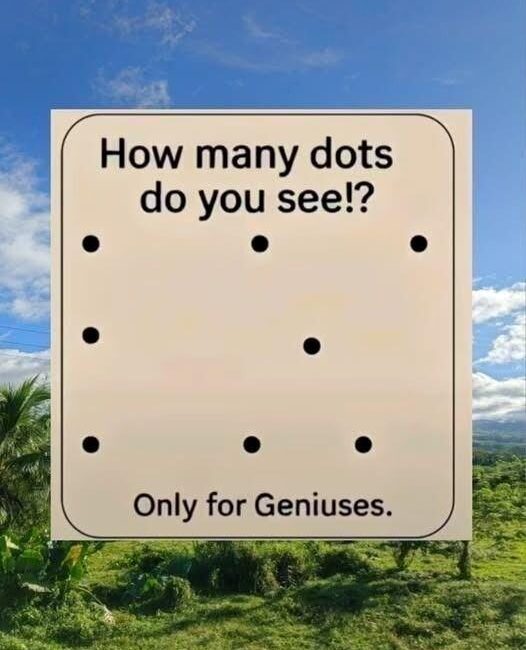
Humans hate unanswered questions. “How many dots do you see?” feels incomplete without closure. The brain wants resolution.
This unresolved tension keeps people engaged far longer than expected. They scroll back. They recount. They zoom in. They show someone else.
The challenge lingers because the mind wants certainty—and the image resists it.
What Your Answer Might Suggest (Lightly)
While not scientific, people love interpretation. Some playful observations often emerge:
- Fast counters may rely on intuition
- Slow counters may value precision
- Higher counts may reflect detail sensitivity
- Lower counts may reflect pattern-based thinking
None of these are better or worse. They are simply different strategies for navigating ambiguity.
When Optical Illusions Teach Humility
These challenges offer a quiet lesson: perception is not reality. It is a model of reality, built under time pressure with limited data.
Recognizing this can be unsettling—but also liberating.
It reminds us that disagreement does not always imply error. Sometimes it reflects different internal processes responding to the same stimulus.
Why Kids and Adults Often See Different Numbers
Children and adults frequently report different dot counts.
Children tend to:
- Count literally
- Focus on individual elements
- Question assumptions less
Adults often:
- Group automatically
- Fill in patterns
- Make unconscious shortcuts
Experience improves efficiency, but sometimes at the cost of precision.
The Frustration Factor
At some point, most people feel frustration.
You recount.
You zoom.
You doubt yourself.
That frustration comes from the brain’s need for certainty in a situation that resists it. The mind wants closure, but the image refuses to cooperate.
There May Not Be One “Correct” Answer
Here is the truth many people resist: some dot challenges are intentionally ambiguous.
Depending on how you define:
- A dot
- An overlap
- A cluster
- A border element
Multiple answers can be valid.
And that is often the point.
What This Teaches Us Beyond the Dots
This tiny challenge mirrors real life more than we realize.
People encounter:
- The same situation
- The same information
- The same event
And walk away with different interpretations.
That doesn’t mean someone is lying or stupid. It means perception varies.
Why Humans Love Testing Themselves
Self-tests feel empowering. They provide:
- Immediate feedback
- A sense of control
- A way to measure oneself
Even when the test is playful, the instinct is serious. We want to know where we stand.
The Satisfaction of “Getting It Right”
If you later learn your count matched the “intended” answer, it feels validating. If it didn’t, curiosity often replaces disappointment.
Either way, engagement happens.
When You Can’t Unsee It
Sometimes, after someone points out extra dots, you suddenly see them—and can’t unsee them.
Your brain updates its model.
That moment, when perception shifts, is powerful. It’s learning in real time.
Why These Tests Stick With Us
Long after scrolling past, people remember:
- The debate
- The surprise
- The disagreement
This is interactive memory. Participation cements recall.
A Gentle Reminder About Vision Health
While these challenges are entertaining, they are not substitutes for proper eye care. Regular eye exams matter. Clear vision isn’t just about counting dots—it’s about long-term health and quality of life.
Final Thoughts: So… How Many Dots Do You See?
The real answer isn’t just a number.
It’s a reminder that:
- Perception is subjective
- Attention shapes reality
- Simple things can be deeply complex
So whether you saw 12, 15, 20, or “more than that,” you passed the real test.
You paused.
You questioned.
You engaged.
And sometimes, that’s exactly the point.