The end piece of bread is one of the most ordinary objects in everyday life, and yet it has sparked more debate, regional pride, childhood arguments, and linguistic creativity than almost any other food-related item. It sits quietly at the edge of the loaf, slightly darker, sometimes thicker, often ignored, occasionally cherished. It is the slice many people avoid and others fight over. It has dozens of names, countless associations, and an identity shaped as much by culture and memory as by language.
Asking “What do you call the end piece of bread?” seems simple. The answer is anything but.
This single slice reveals how language evolves, how families pass down habits, how social class shapes food attitudes, and how everyday objects become symbols of comfort, waste, nostalgia, or practicality. It is a linguistic mirror reflecting geography, upbringing, humor, and even values.
THE OBJECT ITSELF: WHAT MAKES THE END PIECE DIFFERENT
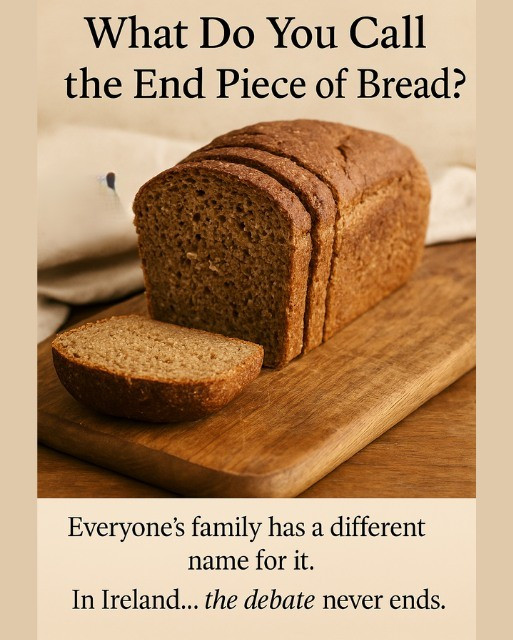
Before exploring names, it is important to understand why the end piece of bread stands apart in the first place. Unlike the uniform slices in the middle of the loaf, the end piece—on either side—has a crust that wraps around almost entirely. Its texture is firmer. Its shape is less predictable. It feels more substantial in the hand and often behaves differently when toasted or spread.
In industrial bread production, the end pieces exist because loaves must be enclosed during baking. In artisanal baking, they are the result of shaping and scoring. In both cases, they are structurally necessary. Without them, the loaf would dry out faster, lose freshness, and collapse more easily.
Ironically, the slice that protects the rest of the bread is the one most frequently rejected.
WHY PEOPLE DISAGREE ABOUT IT SO STRONGLY
The end piece of bread is emotionally loaded in a way few foods are. This is because it intersects with:
- Childhood habits
- Household rules
- Scarcity or abundance
- Texture sensitivity
- Cultural food norms
For some people, the end piece represents waste. For others, it represents efficiency. Some see it as inferior; others consider it superior. These differences often form early and stick for life.
Because bread is such a staple food, repeated exposure cements opinion. People don’t just dislike or like the end piece casually—they develop identity-level preferences around it.
THE MOST COMMON NAME: “THE HEEL”
In many English-speaking regions, particularly in parts of the United States, the United Kingdom, and Australia, the end piece of bread is called the heel.
This term evokes anatomy. The heel is the back or base of something, the supporting end. Linguistically, it frames the bread as a body, with the heel holding everything together.
For many families, “the heel” carries a slightly negative tone. It is the piece left behind. The one nobody chooses first. The one someone eventually eats out of obligation.
Yet in other households, the heel is prized for its sturdiness. It holds spreads better. It doesn’t fall apart in soup. It toasts evenly.
The same word, two opposite meanings.
“THE BUTT”: BLUNT, HUMOROUS, AND REGIONAL
Another common term, especially in parts of North America, is the butt.
This name is more informal, sometimes controversial, and often used with humor. It describes the end piece as the “backside” of the loaf, emphasizing its position rather than its function.
Families that use this term often do so casually, without embarrassment. For children growing up with it, “the butt” becomes a normal, even affectionate term. For others encountering it for the first time, it can feel jarring or inappropriate.
This difference alone highlights how language norms are shaped locally, not universally.
“THE END”: PRACTICAL AND UNEMOTIONAL
Some people simply call it the end.
This term strips away metaphor and judgment. It is purely descriptive. It is the end of the loaf, nothing more, nothing less.
Interestingly, households that use this term often treat the end piece neutrally. It is neither avoided nor favored. It is just another slice, eaten when reached.
This naming reflects a practical mindset toward food: bread is bread, and slices are slices.
“THE CRUST”: A COMMON MISNOMER
Many people refer to the end piece as the crust, though technically all slices have crust.
This linguistic shortcut reveals something important: perception matters more than accuracy. The end piece feels more crusty, so it becomes “the crust” in everyday speech.
Children are especially likely to use this term, often because they are taught to avoid “the crust.” Over time, the association hardens, and the end piece becomes synonymous with what is undesirable.
This contributes to food waste in many households, as end pieces are thrown away or left to stale.
REGIONAL AND DIALECTAL VARIATIONS
Beyond the most common names, regional language explodes into creativity.
Some people call it:
- The knobby
- The nub
- The cap
- The nose
- The stump
- The top or bottom slice
In some dialects, the front and back end pieces even have different names.
These variations are not random. They reflect local speech patterns, humor styles, and cultural comfort with metaphor. They also show how everyday objects become playgrounds for linguistic invention.
CLASS, SCARCITY, AND THE END PIECE
Attitudes toward the end piece of bread often correlate with experiences of scarcity.
In households where food insecurity existed, the end piece was rarely wasted. It was eaten, repurposed, toasted, or saved. Calling it something dismissive would have felt absurd.
In households of abundance, where bread could be replaced easily, the end piece became optional. Naming it humorously or negatively carried no cost.
This divide persists subtly today. Some people instinctively save the end piece for breadcrumbs or stuffing. Others throw it away without a second thought.
Language follows behavior.
WHY SOME PEOPLE LOVE IT
Despite its reputation, many people genuinely prefer the end piece.
Reasons include:
- Extra crust provides better texture
- More structure for sandwiches
- Superior toasting qualities
- Nostalgic association with childhood
For these individuals, the end piece is not a burden but a reward. Some even save it deliberately.
In these cases, naming reflects pride rather than avoidance. The heel becomes a feature, not a flaw.
FAMILY DYNAMICS AND THE END PIECE
Few foods expose family dynamics as clearly as the end piece of bread.
Who eats it?
Who avoids it?
Who assigns it?
In some households, it is given to the youngest. In others, to the parent. Sometimes it becomes a test of politeness or self-sacrifice.
These micro-interactions teach children about fairness, hierarchy, and food value—often without anyone realizing it.
The name used within the family becomes shorthand for these dynamics.
LANGUAGE AS A SOCIAL SIGNAL
Asking someone what they call the end piece of bread often reveals more than preference. It reveals origin.
Accent, region, upbringing, and even humor style emerge instantly from the answer. It is a linguistic fingerprint.
This is why the question circulates so widely in casual conversation. It feels light, but it carries depth.
People recognize themselves in their answer.
THE END PIECE IN PROFESSIONAL KITCHENS
In professional food environments, the end piece is rarely treated casually.
Bakers, chefs, and caterers understand its value. It is used for:
- Breadcrumbs
- Croutons
- Bread pudding
- Thick toast bases
In these contexts, it is not named playfully or dismissively. It is inventory.
This professional respect contrasts sharply with domestic neglect and highlights how context shapes value.
PSYCHOLOGY OF AVERSION AND PREFERENCE
From a psychological perspective, aversion to the end piece often comes down to expectation mismatch.
People expect uniformity from sliced bread. The end piece breaks that expectation. Humans are surprisingly sensitive to inconsistency in food texture and shape.
Those who dislike it often do so subconsciously, not rationally. Those who like it tend to appreciate variation.
This explains why opinions are often intense and non-negotiable.
WHY THE DEBATE NEVER ENDS
The debate over what to call the end piece of bread persists because it has no correct answer.
Language is descriptive, not prescriptive. Meaning is created by use, not consensus.
As long as people grow up in different households, regions, and cultures, the end piece will continue to collect names.
And as long as bread remains a staple, the conversation will continue.
WHAT THE QUESTION REALLY ASKS
On the surface, the question is about bread.
Underneath, it asks:
- Where are you from?
- How did you grow up?
- What do you value?
- How do you relate to food?
That is why it resonates so strongly and spreads so easily.
It is a harmless question with profound reach.
A SLICE OF HUMANITY
The end piece of bread is humble, overlooked, and endlessly debated. It is shaped by ovens and hands, but defined by people.
Whether you call it the heel, the butt, the crust, the end, or something entirely your own, the name carries history.
Not the history of bread—but the history of you.
And perhaps that is why such a small slice can say so much.