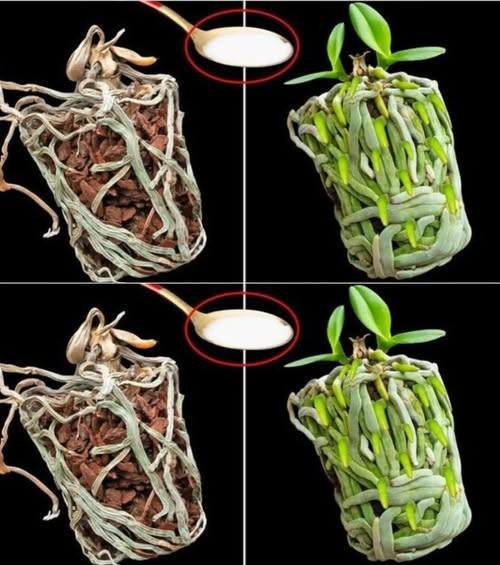
Orchids reward patience. They operate on their own timeline, not ours.
Why This Works Better Than Heavy Feeding
Many people attempt to revive orchids by increasing fertilizer strength, assuming more nutrients equal faster recovery. This often backfires.
Orchid roots are sensitive. Concentrated fertilizers can burn delicate root tips, setting recovery back weeks or months.
The spoon method avoids this by delivering nutrients at levels the plant can actually absorb. This supports steady, sustainable growth rather than forcing rapid development.
Healthy roots grow because conditions are right—not because they are pushed.
Common Mistakes That Undermine Recovery
Even with the spoon method, mistakes can stall progress.
Using tap water high in salts or minerals can interfere with root function. If possible, use filtered or rainwater.
Letting the pot sit in standing water suffocates roots. Drainage is essential.
Placing the orchid in low light slows recovery. Bright, indirect light supports root energy production.
Fertilizing too often—even in small amounts—can accumulate salts. Periodic flushing with plain water helps prevent buildup.
Avoiding these pitfalls dramatically increases success.
When the Pot Suddenly Fills With Roots
One of the most rewarding moments in orchid care is lifting the pot and seeing healthy roots pressing against the sides, winding through the medium, and even emerging from drainage holes.
This is not a problem. It is a sign of success.
Orchids like to be slightly root-bound. It gives them stability and improves airflow around roots. Repot only when the medium breaks down or roots become excessively crowded.
A pot full of roots means the plant is strong enough to support future blooms.
From Survival to Blooming Again
Root recovery is the foundation, but flowering follows naturally once the plant is stable.
With a healthy root system:
Water absorption becomes efficient
Nutrient transport improves
Energy reserves rebuild
In time, new flower spikes may emerge, often stronger than before.
This transformation—from dried and neglected to vibrant and blooming—feels almost miraculous, but it is simply biology responding to proper care.
Why This Method Feels Like Magic
The spoon method stands out because it contradicts common instincts. Instead of adding more, it focuses on adding less—but with intention.
It replaces panic with precision.
People are often shocked by how little is required to spark such dramatic change. That shock is what makes the method memorable and widely shared.
Seeing a lifeless orchid fill its pot with new green roots feels like witnessing a secret unlocked.
A Lesson Beyond Orchids
This approach teaches a broader lesson about care—of plants and of living systems in general.
Growth does not respond to force.
Recovery does not come from excess.
Revival begins with balance.
Sometimes, the simplest tool—a spoon—is enough when used thoughtfully.
Final Reflection: A Small Action With Remarkable Results
A dried orchid is not a failure. It is a pause. A moment waiting for the right signal.
By understanding how orchids grow and responding with patience and precision, it is entirely possible to reverse decline and trigger explosive root growth.
Just a spoon.
A little knowledge.
And time.
Soon, what once looked lifeless fills the pot with new, green roots—quiet proof that resilience often hides where we least expect it.