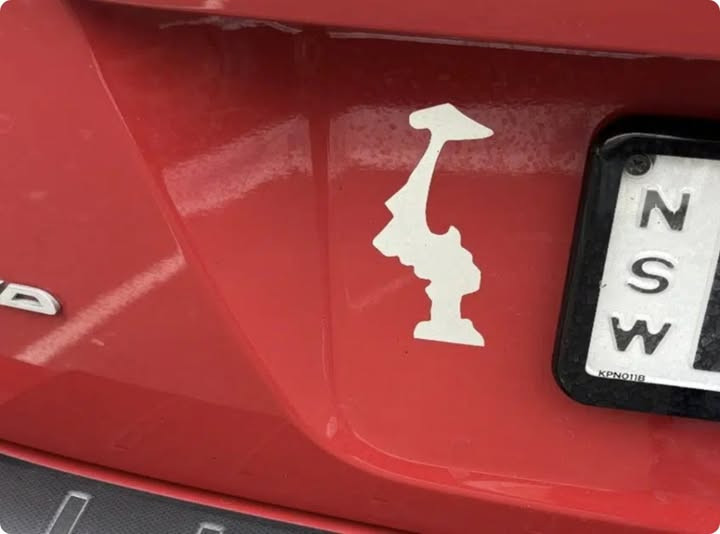
You’ve probably noticed it without fully understanding it. A familiar outline on the back of a car — unmistakably the shape of Washington State — but something feels off. The coastline is flipped. The Olympic Peninsula curves downward instead of up. Mount Rainier’s implied presence feels inverted. At first glance, it looks like a mistake, a careless application of a sticker by someone who didn’t bother to check orientation.
But it isn’t a mistake. Not even close.
The upside-down Washington State sticker is intentional, deliberate, and layered with meaning. It is one of those quiet cultural signals that says everything to the people who recognize it — and absolutely nothing to those who don’t. It doesn’t shout. It doesn’t explain itself. It just exists, flipped, confident, and oddly magnetic.
What looks like a simple decal is, in reality, a compact symbol of identity, humor, displacement, nostalgia, rebellion, and belonging — all at once.
THE RISE OF THE STATE OUTLINE STICKER
To understand why anyone would flip a state sticker upside down, it helps to understand how state outline decals became popular in the first place.
Over the past decade, minimalist design has dominated visual culture. Clean lines. Simple shapes. Instantly recognizable forms. The outline of a U.S. state fits perfectly into that aesthetic. No words needed. No explanation required. If you know, you know.
These decals became especially popular among people who travel frequently, live outdoors, or strongly identify with where they come from. They appeared on laptops, water bottles, camper vans, trailhead vehicles, and rear windows. They were subtle declarations of origin and pride.
Washington State, in particular, became a favorite. Its outline is dramatic and distinctive, shaped by water, mountains, and coastline. Unlike many states that appear boxy or symmetrical, Washington looks wild — just like the landscape itself.
And then someone turned it upside down.
THE FIRST FLIP — AND WHY IT STUCK
No one knows exactly who flipped the first Washington sticker. There was no announcement, no movement, no official explanation. It simply appeared one day, and others noticed.
The flipped version immediately did something the original could not: it disrupted expectation.
People stopped. They stared. They asked questions. And that curiosity became part of the appeal.
Inverting the sticker transformed it from a generic expression of pride into a conversation starter. It introduced ambiguity. Was it ironic? Political? Accidental? Emotional?
The answer depended entirely on who you asked.
HUMOR AND IRONY: “I’M FROM WASHINGTON, BUT I DON’T TAKE MYSELF TOO SERIOUSLY”
For many drivers, the upside-down sticker is first and foremost a joke.
It’s a subtle form of humor — the kind that doesn’t need a punchline. A visual wink. A playful refusal to participate in overly earnest displays of identity.
It says:
Yes, I’m from Washington.
Yes, I love it.
No, I’m not going to present it in the most predictable way possible.
In a world where bumper stickers often shout opinions, the inverted Washington outline feels refreshingly understated. It mocks nothing directly, yet it gently pokes fun at the seriousness with which people sometimes display regional pride.
DISPLACEMENT AND DIASPORA: WHEN HOME IS FAR AWAY
For many others, the meaning runs much deeper.
A significant number of upside-down Washington stickers are displayed by people who no longer live in the state. They moved away for work, school, love, adventure, or necessity. Their lives were, quite literally, turned upside down.
Flipping the sticker becomes a visual metaphor. Home is still home — but life is no longer oriented around it.
The inversion expresses dislocation without bitterness. It acknowledges distance without severing connection. It’s a way of saying: I’m not there anymore, but it’s still part of me.
For people living abroad or across the country, the sticker becomes a portable memory. A reminder. A grounding object in unfamiliar places.
A SIGNAL TO OTHER WASHINGTONIANS
Another reason the sticker endures is that it functions as a quiet identifier.
Spotting an upside-down Washington decal often sparks immediate recognition among people from the same region. It’s not flashy enough for strangers to comment on, but it’s specific enough to catch the eye of those who know.
In parking lots, trailheads, and campsites, it creates moments of instant connection. A nod. A smile. A brief conversation about rain, mountains, ferries, or coffee that somehow always matters more than it should.
Click page 2 to continue