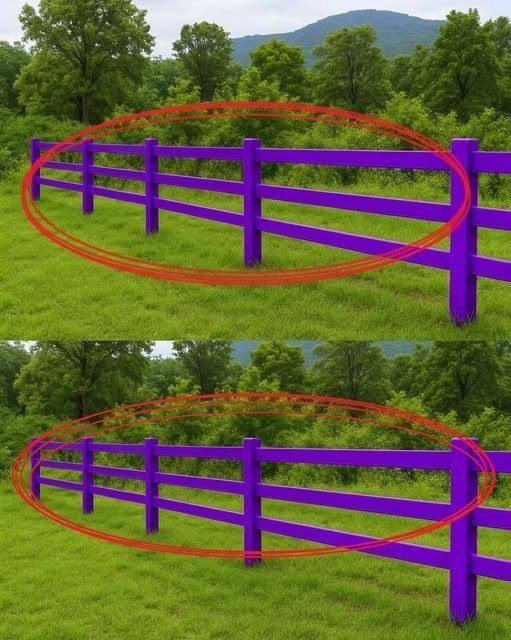
At first glance, a purple stripe painted on a tree trunk or a fence post can feel strange, even decorative. It does not look official. There is no text, no symbol, no warning in bold letters. And yet, in many parts of the United States, that single vertical mark carries the same legal weight as a “No Trespassing” sign. In some situations, it carries even more.
What looks like a simple brushstroke is actually the result of years of legal evolution, practical necessity, and rural reality. Purple paint is not random, not artistic, and not optional decoration. It is a legally recognized boundary marker in multiple states, and ignoring it can have real consequences.
Understanding why it exists, how it works, and where it applies reveals a lot about how property law adapts to environment, culture, and practicality.
WHY “NO TRESPASSING” SIGNS WERE NOT ALWAYS PRACTICAL
For decades, the standard way to mark private land was with posted signs. Metal signs, wooden signs, printed warnings nailed to trees or fences. On paper, this seemed sufficient. In reality, it often failed.
In rural and wooded areas, signs are vulnerable. Wind tears them down. Rain rusts them. Snow buries them. Wildlife knocks them loose. People steal them, vandalize them, or remove them intentionally. In large properties stretching for miles, maintaining signs becomes expensive and time-consuming.
Landowners found themselves in a frustrating position. Even when they clearly intended to restrict access, missing or damaged signs created legal gray areas. Trespassers could claim they never saw a warning. Courts often sided with ambiguity.
This problem demanded a solution that was visible, durable, inexpensive, and difficult to remove.
HOW PURPLE PAINT BECAME A LEGAL SOLUTION
The answer emerged quietly: paint.
Paint does not rust. It does not blow away. It does not fall over. When applied to trees or posts, it becomes part of the landscape itself. Unlike signs, it cannot be easily removed without obvious effort.
Lawmakers in several states recognized that painted boundary markers could provide clearer, more reliable notice of private property. Over time, statutes were written to define exactly what kind of paint markings would count as legal notice.
Purple was chosen deliberately.
WHY THE COLOR PURPLE WAS SELECTED
Purple is rare in nature. In forests, fields, and rural landscapes, it does not blend in with bark, leaves, or soil. It stands out clearly against wood, metal, and natural surfaces.
It is also culturally neutral. Unlike red, which may imply danger, or white, which fades quickly, purple has no conflicting meaning in outdoor environments. It does not resemble hunting markers, trail blazes, or utility company paint codes.
Most importantly, purple is consistent. Once people learn its meaning, it becomes instantly recognizable.
This consistency is what gives the system its strength.
THE LEGAL REQUIREMENTS THAT MAKE IT VALID
Purple paint only works as a legal boundary marker if it follows specific rules. These rules are not suggestions. They are precise because courts rely on them to determine whether proper notice was given.
The paint must be applied as vertical lines, not dots, splashes, or horizontal marks. Vertical stripes are intentional and unmistakable.
Each stripe must be at least one inch wide and eight inches long. This ensures visibility from a reasonable distance.
The height matters. The paint must be placed between three and five feet off the ground. Too low, and it gets hidden by grass or snow. Too high, and it may be obscured by foliage or overlooked.
Spacing is equally important. Markings should appear approximately every 100 feet along the property boundary. This prevents gaps where someone could claim they never encountered a warning.
When these conditions are met, the purple paint functions as a clear legal statement: entry beyond this point is not permitted.
WHICH STATES RECOGNIZE THE PURPLE PAINT LAW
Not all states recognize purple paint as a substitute for posted signage. This is critical.
States that have formally adopted versions of the Purple Paint Law include Texas, Illinois, Missouri, North Carolina, Arkansas, Indiana, Kansas, Montana, and several others. Each state may have slight variations in measurements or spacing, but the core concept remains the same.
In these states, purple paint carries legal authority. Trespassers cannot claim ignorance if the markings meet statutory requirements.
In states without such laws, purple paint has no legal meaning. It may confuse hikers or passersby, but it does not establish legal notice on its own.
This is why checking local statutes is essential for landowners. A method that works perfectly in one state may be legally meaningless in another.
WHY LANDOWNERS PREFER PURPLE PAINT
From a landowner’s perspective, purple paint solves multiple problems at once.
It is inexpensive. A single can of paint can mark large stretches of land.
It is durable. Once applied, it can last for years with minimal maintenance.
It is discreet. Unlike signs, it does not clutter the landscape or draw attention to the property.
It is hard to dispute. Painted trees and posts are not easily removed without leaving evidence.
For owners of farmland, forests, hunting land, or remote acreage, this method provides peace of mind without constant upkeep.
WHAT TRESPASSERS AND VISITORS OFTEN GET WRONG
Many people still assume that only posted signs matter. They believe that if there is no written warning, entry is allowed. This assumption is outdated in states that recognize purple paint.
Others mistake purple markings for trail indicators, survey paint, or vandalism. This misunderstanding can lead people onto private land without realizing they are committing an offense.
Ignorance does not always protect against legal consequences. In areas where purple paint is legally defined, courts treat it as sufficient notice.
This is especially important for hunters, hikers, and outdoor explorers who travel through rural areas.
THE ROLE OF PURPLE PAINT IN HUNTING AND OUTDOOR ACTIVITIES
The Purple Paint Law has strong ties to hunting culture. Hunters often cross large tracts of land, sometimes moving between public and private property unknowingly.
Clear, durable boundary markers reduce accidental trespassing and conflict between landowners and sportsmen. They provide a visual cue that is difficult to miss if one is paying attention.
This system protects both sides. Landowners gain control over access. Responsible hunters gain clarity about where they are allowed to be.
WHY THIS SYSTEM IS GROWING IN POPULARITY
As land use changes and rural areas become more active, the need for clear boundaries increases. Traditional signage has proven unreliable. Technology-based solutions are expensive and impractical for large properties.
Purple paint sits at the intersection of simplicity and effectiveness. It requires no electronics, no maintenance contracts, and no infrastructure.
It relies on visibility, consistency, and law.
That combination is powerful.
WHAT PURPLE PAINT REALLY REPRESENTS
At its core, the purple paint marking is about communication. It is a silent but firm message: this land is privately owned, and access is restricted.
It reflects a shift in how law recognizes real-world conditions. Instead of assuming ideal circumstances where signs remain intact and visible, the law adapts to nature, weather, and human behavior.
The paint does not shout. It does not threaten. It simply states a boundary.
A SIMPLE MARK WITH SERIOUS MEANING
To someone unfamiliar with its purpose, a purple stripe may look unimportant. To those who understand it, it is unmistakable.
It is not decoration.
It is not random.
It is not optional.
In the states where it applies, it is law expressed through color.
So the next time you see a vertical purple line on a tree or fence post while exploring back roads, hiking trails, or wooded land, understand what it means. You are being warned, quietly but clearly, that you are approaching private property.
What appears to be a simple paint mark is actually a boundary, a legal statement, and a reminder that even the smallest symbols can carry significant authority when backed by law.