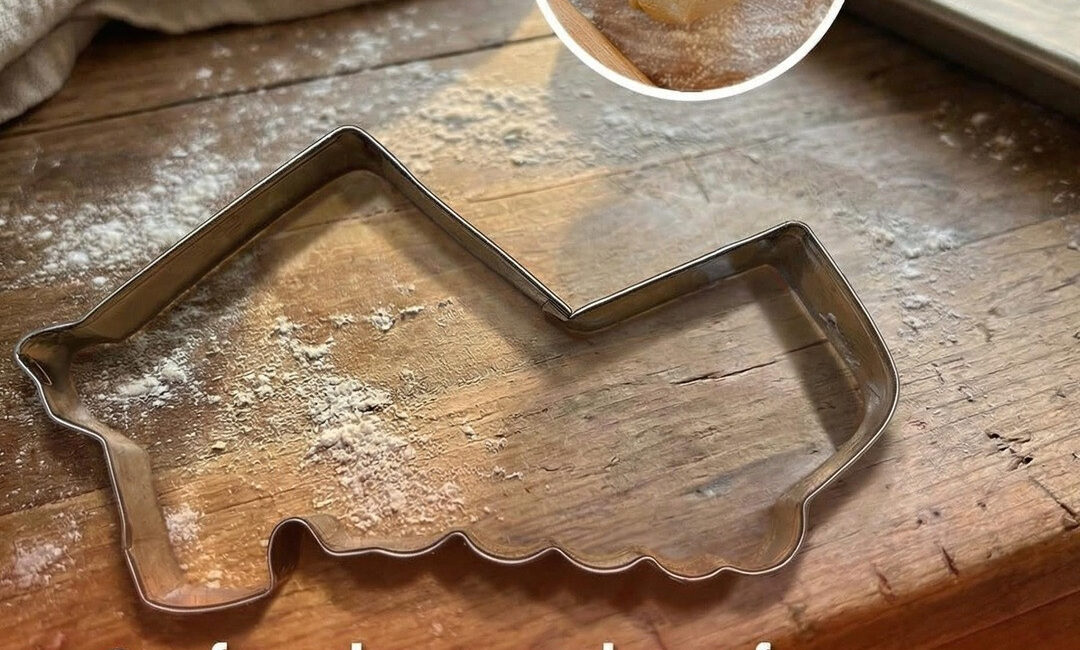
At first glance, the scene looks ordinary and warm: a wooden table lightly dusted with flour, soft daylight coming through a window, baking trays waiting nearby. It is the kind of setting associated with comfort, routine, and familiarity. Then there is the cookie cutter. Thin metal. An irregular outline. No obvious reference point. No immediate meaning. And suddenly, something as simple as holiday baking turns into a full-blown mystery.
Among a Christmas-themed set filled with recognizable shapes—trees, snowmen, festive icons—this one stood apart. It refused to explain itself. No matter how it was rotated, flipped, or imagined, it did not resolve into anything familiar. The mind kept reaching for recognition and coming up empty. That discomfort, small but persistent, is what transformed this object from a baking tool into a viral puzzle.
This was not about cookies anymore. It was about perception, expectation, and the strange frustration that arises when the brain cannot close a loop.
WHY THE BRAIN DEMANDS RECOGNITION
Human perception is deeply tied to pattern recognition. The brain is constantly trying to answer a single question: “What is this?” When the answer arrives quickly, the mind relaxes. When it does not, tension builds.
Cookie cutters are especially dependent on recognition. Their entire purpose is symbolic. A cookie cutter does not just cut dough; it promises a shape, a meaning, an identity. A star is a star before it even touches dough. A tree is already a tree in the mind.
This cutter broke that contract. It offered no immediate symbol. No animal. No object. No holiday icon. The brain searched its library of familiar shapes and found nothing that fit cleanly.
That failure is surprisingly unsettling.
ROTATION, REINTERPRETATION, AND MENTAL FATIGUE
One of the first instincts when faced with an ambiguous shape is rotation. Turn it upside down. Flip it sideways. Try to see it from another angle. This is a classic perceptual strategy, and it usually works.
In this case, rotation only deepened the confusion. Each new orientation suggested a different partial idea—maybe a house, maybe stacked objects, maybe a boot, maybe a bow—but none held together convincingly. Each interpretation collapsed under scrutiny.
This constant near-recognition is mentally exhausting. The brain feels like it is on the edge of understanding but never quite arrives. That is the hallmark of a good visual puzzle: it keeps perception suspended between certainty and doubt.
WHY SHARING THE IMAGE WAS INEVITABLE
When the mind cannot resolve something alone, it seeks collective intelligence. Posting the image online was not just a request for answers; it was an invitation to share the cognitive load.
Once the photo appeared on Reddit, the mystery expanded beyond one kitchen table. Hundreds of brains began working on the same shape. Some approached it analytically, tracing edges and proportions. Others leaned into creativity, turning the outline into cartoons, scenes, or abstract designs.
This diversity of responses reveals something important: when meaning is unclear, people project. The same shape became different things depending on imagination, cultural references, and personal bias.
THE MOST POPULAR THEORY AND WHY IT FELT RIGHT
Among the many suggestions, one idea gained traction: stacked Christmas presents. The stepped outline, the layered levels, the uneven top—all of it could be interpreted as boxes piled on top of one another, perhaps with a bow or stocking element.
This theory resonated not because it was provably correct, but because it satisfied the brain’s need for narrative. It turned chaos into structure. It aligned with the holiday theme. It allowed the mind to finally rest.
Not everyone agreed. Some pointed out inconsistencies. Others proposed alternative explanations. But the popularity of the idea showed how quickly humans gravitate toward explanations that feel emotionally coherent, even if they are not confirmed.
WHY THE MYSTERY DID NOT NEED A FINAL ANSWER
What made this moment special was not the solution, but the process. The mystery never fully resolved, and that became part of its charm.
In a world where information is instantly accessible, where answers are expected on demand, this small unsolved puzzle offered something rare: shared uncertainty. People were allowed to not know. They were allowed to speculate, laugh, disagree, and create without pressure to conclude.
The cookie cutter became a canvas rather than a problem.
PERCEPTION, EXPECTATION, AND EVERYDAY OBJECTS
This story highlights how much meaning we attach to everyday tools. A cookie cutter is supposed to be obvious. When it is not, it feels almost wrong. That reaction reveals how deeply expectation shapes perception.
The object itself did nothing unusual. It did not change shape. It did not hide information. The confusion existed entirely in the mind of the observer. That makes the experience fascinating rather than frustrating.
It shows how quickly the brain moves from comfort to curiosity when a familiar pattern breaks.
WHY THESE SMALL PUZZLES MATTER
At a surface level, this was a harmless holiday anecdote. At a deeper level, it was a reminder of how humans engage with ambiguity.
Small mysteries like this create low-stakes cognitive play. They encourage conversation. They invite imagination. They slow people down in a season often dominated by urgency and expectation.
During the holidays especially, such moments act as social glue. They give people something light to gather around, something to enjoy without consequence.
FROM METAL OUTLINE TO SHARED EXPERIENCE
The cookie cutter did not need to be identified to fulfill its purpose. It already succeeded in a different way. It created connection. It sparked creativity. It reminded people that confusion can be enjoyable when shared.
In the end, the shape may still be unclear. But the experience it generated was unmistakable.
A simple piece of bent metal, resting on a flour-dusted table, managed to do what many perfect objects cannot. It made people pause, think, imagine, and smile together.
Sometimes, not knowing is the point.