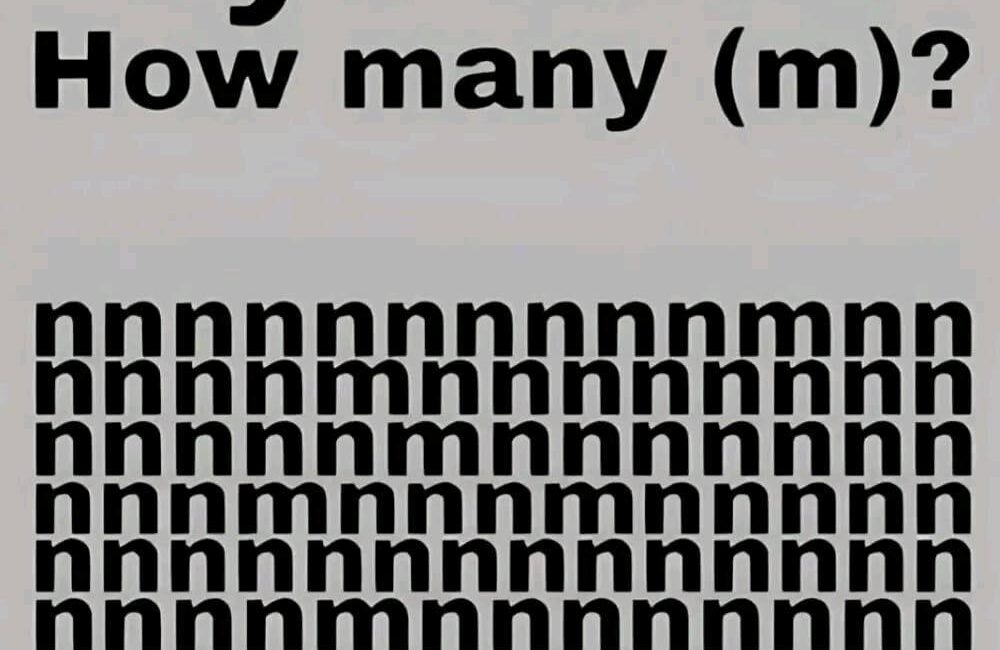
It usually means:
- Your brain processes images globally
- You rely on overall patterns rather than details
- You trust visual consistency
In everyday life, this is a strength.
In illusion puzzles, it’s a disadvantage.
Your brain is saying:
“Nothing changed. Stop wasting time.”
But the puzzle depends on you questioning that assumption.
The Psychological Trap Hidden in the Caption
Phrases like:
- “Most people get this wrong”
- “Something changed”
- “Find out in the first comment”
…create expectation bias.
You start looking for:
- Movement
- Color changes
- Big differences
But the real change is microscopic.
That mismatch between expectation and reality makes the puzzle even harder.
How to Spot the “m” Faster (Without Spoilers)
If you’re still looking, here’s how people usually succeed:
- Stop scanning randomly
- Look row by row
- Focus on the vertical strokes
- Count how many “legs” each letter has
An “n” has two vertical strokes.
An “m” has three.
Once your brain locks onto that rule, the illusion collapses instantly.
Why This Feels So Satisfying When You Finally See It
That “aha!” moment isn’t just emotional — it’s neurological.
Your brain:
- Abandons a false assumption
- Rebuilds the image correctly
- Rewards you with dopamine
That’s why these puzzles are so addictive.
They give you a tiny, safe experience of being wrong — and then correcting it.
What This Puzzle Quietly Teaches Us
Beyond entertainment, this image is a perfect metaphor for everyday life.
It shows that:
- Repetition hides differences
- Familiarity breeds blindness
- Small details matter
- First impressions are incomplete
Sometimes, what we miss isn’t hidden — it’s too familiar.
A Final Thought
The “m” was always there.
It didn’t move.
It didn’t change.
It didn’t reveal itself.
The only thing that changed was how you looked.
And that’s why this simple little image keeps going viral — because it reminds us that seeing isn’t just about eyes.
It’s about attention.