Something’s Not Quite the Same — Can You Spot It?
At first glance, this image looks almost boring.
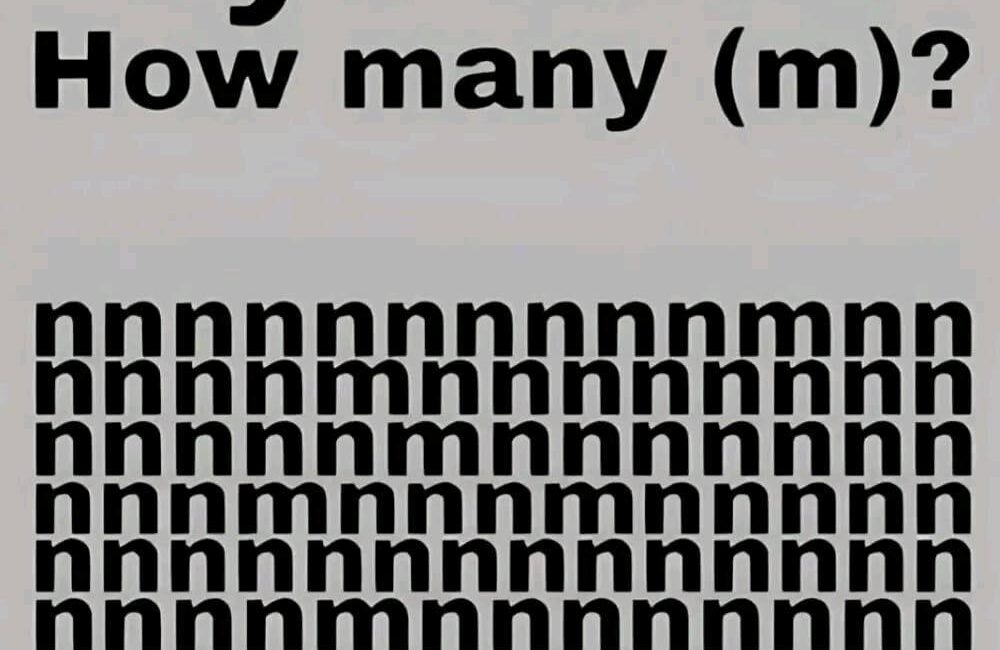
Rows and rows of the same letter.
Nothing unusual. Nothing special.
Your brain skims it, labels it “all the same,” and wants to move on.
But that’s exactly where the trick lies.
Because something in this image is different — and once you notice it, you’ll wonder how you missed it in the first place.
Welcome to one of the simplest yet most frustrating visual tests out there:
How many “m” letters are hiding among all those “n”s?
Why This Image Is So Tricky (Even Though It Looks Easy)
Your eyes aren’t the problem.
Your brain is.
The human brain is designed to:
- Recognize patterns quickly
- Group similar shapes together
- Ignore small differences to save energy
When you see repeated “n” shapes, your brain switches to autopilot. It assumes everything is identical and stops checking carefully.
That’s efficient for survival.
But terrible for puzzles like this.
The lowercase “m” is almost identical to an “n”, except for one extra stroke. And when the font is bold and tightly spaced, that difference becomes extremely subtle.
Your brain says:
“I already know what this is.”
And stops looking.
What You’re Actually Being Tested On
This isn’t really an eye test.
It’s a selective attention test.
It measures:
- How well you notice small inconsistencies
- How quickly your brain abandons assumptions
- Whether you scan systematically or randomly
People who struggle with this puzzle are not less intelligent. In fact, they often have brains that are too good at pattern recognition, which causes them to overlook anomalies.
Why Some People Spot the “m” Instantly
If you found the “m” quickly, you likely:
- Scan images line by line
- Focus on structure, not just shape
- Naturally look for errors or exceptions
- Don’t fully trust first impressions
Your brain doesn’t settle easily. It keeps checking.
This trait often appears in people who are good at:
- Proofreading
- Debugging
- Quality control
- Problem-solving
- Detail-oriented tasks
Why Others Can Stare at It for Minutes
If you struggled, that doesn’t mean your vision is bad.
Click page 2 to continue