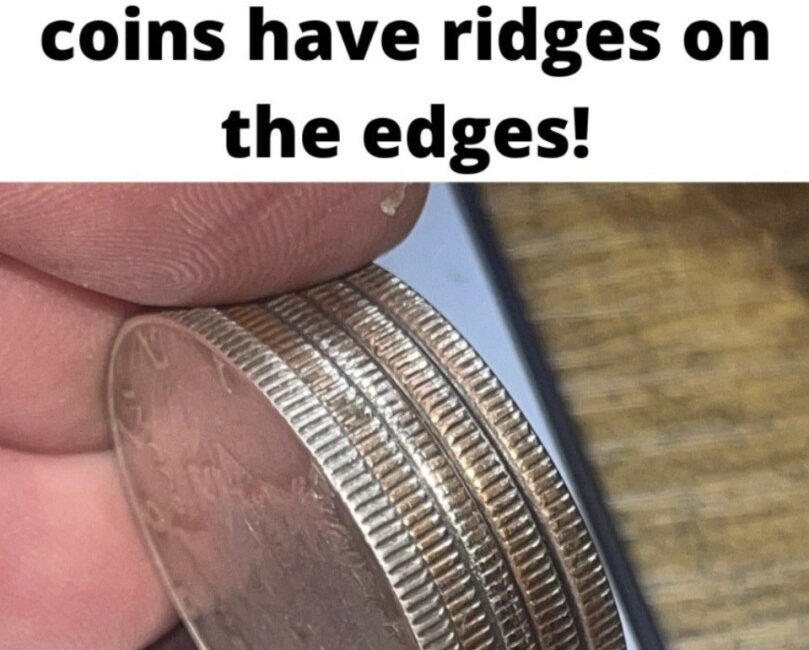
This benefit wasn’t planned in Newton’s time — but it’s one of the most humane design victories in history.
For people who are blind or low-vision, texture is information.
Smooth edge? Penny or nickel.
Ridged edge? Dime, quarter, or half-dollar.
Coins can be identified by touch alone.
That’s inclusive design — centuries before the term existed.
3. Familiarity and Trust
Coins with ridges feel like money.
They sound different when they clink.
They roll differently.
They feel deliberate.
In a world drifting toward digital payments, tactile trust still matters. The physical design reinforces the psychological sense that “this object has value.”
We trust what feels intentional.
Why Some Coins Are Smooth
You’ve probably noticed the pattern:
- Pennies → smooth
- Nickels → smooth
- Dimes → ridged
- Quarters → ridged
Why?
History.
Pennies and nickels never contained precious metals. There was no incentive to clip them. No silver meant no crime.
Reeding followed value.
Even though modern coins are no longer precious, the design language remains — partly for security, partly for consistency, partly because changing it would cause confusion.
Half-dollars still have ridges too, even though most people rarely see one.
A Design Principle Bigger Than Coins
Coin ridges are part of a larger idea that still shapes modern security:
Make tampering obvious.
That principle lives on in:
- Watermarks on paper bills
- Holograms on credit cards
- Security threads inside currency
- Microprinting and color-shifting ink
The goal isn’t to make fraud impossible.
It’s to make it detectable.
Once detection becomes easy, crime becomes risky.
And once crime becomes risky, it fades.
The Quiet Genius of Small Details
We tend to think history lives in books, wars, and monuments.
But sometimes, it lives in your pocket.
Those tiny ridges on a coin are the result of:
- Economic collapse
- Criminal ingenuity
- Scientific thinking
- A physicist who refused to tolerate fraud
They are proof that thoughtful design can outlive empires.
So next time you hold a coin, don’t just spend it.
Run your thumb along the edge.
You’re touching a 300-year-old idea — one that quietly beat criminals, stabilized economies, and still works today.
Not bad for a few tiny lines of metal.