On some designs, the hole also acts as a visual heat indicator. When steam or heat escapes near the handle, it reminds you that:
- The pot is hot
- Steam is active
- Gloves or towels are needed
It’s a passive safety cue—one you notice subconsciously.
5. Lid Storage Hack (Underrated and Brilliant)
Certain pot-and-lid combinations allow the lid handle or edge to rest inside or against the handle hole, creating temporary lid storage.
This is especially useful when:
- You’re stirring frequently
- You don’t want condensation on the counter
- You need quick access to the lid again
Instead of placing a dripping lid on your workspace, you keep everything contained.
Not all pots support this perfectly—but when they do, it feels like a hidden upgrade.
6. Measuring and Portion Control (Yes, Really)
Some manufacturers design the hole to correspond loosely to standard utensil handle widths or serving tools.
Cooks use it as:
- A quick guide for utensil size compatibility
- A reference for hanging systems
- A consistent grip point
In industrial kitchens, consistency matters. The hole provides a reference point that keeps tools interchangeable and predictable.
7. Structural Integrity and Weight Distribution
From an engineering perspective, the hole isn’t empty space—it’s strategic subtraction.
Removing material:
- Reduces overall weight
- Improves balance
- Lowers wrist fatigue
This is especially important for larger pots filled with liquid. The hole shifts the center of mass slightly inward, improving control during lifting and pouring.
It’s one of those changes you don’t consciously notice—but your body does.
8. Cleaning and Drying Benefits
After washing, moisture loves to hide where metal meets metal.
The hole:
- Allows water to drain faster
- Improves airflow during drying
- Reduces trapped moisture near the handle joint
Over time, this helps prevent:
- Rust
- Odors
- Mineral buildup
Small feature. Long-term impact.
9. Emergency Grip or Tie Point
In outdoor cooking, camping, or improvised kitchens, the hole becomes surprisingly useful.
It can be used to:
- Secure the pot with a cord
- Hang it over an open flame
- Stabilize it during transport
This wasn’t the original intention—but good design invites adaptability.
10. Why This Tiny Hole Is a Lesson in Good Design
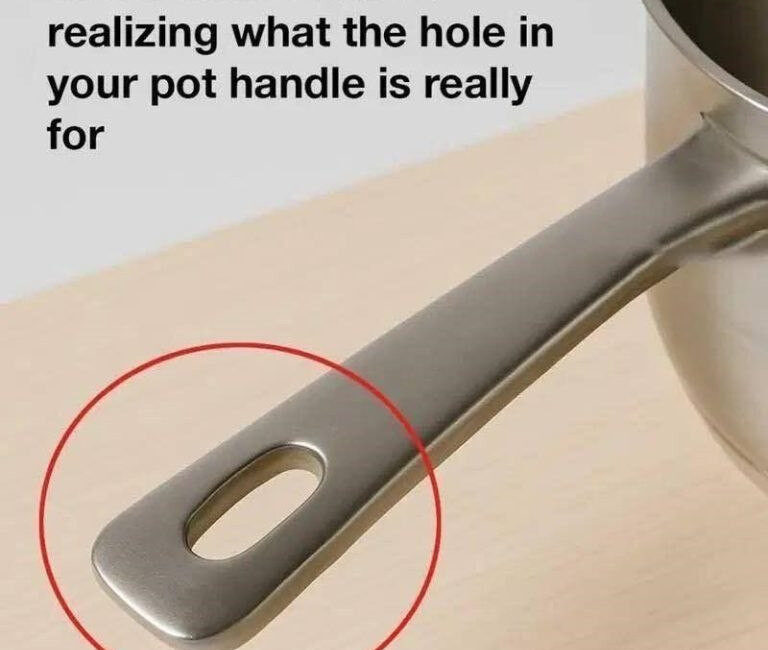
The hole in your pot handle is a perfect example of quiet intelligence.
It:
- Solves multiple problems at once
- Requires no instructions
- Doesn’t draw attention to itself
- Improves safety, cleanliness, and efficiency
The best designs don’t announce themselves. They just work—again and again—until you stop noticing them.
Final Thought
That small hole isn’t there by accident. It’s the result of accumulated kitchen wisdom, engineering decisions, and decades of real-world cooking habits.
Once you start using it beyond hanging, it becomes:
- A cleaner workspace
- A safer cooking process
- A more intuitive kitchen experience
And that’s the beauty of good tools.
They don’t demand your attention.
They reward it.