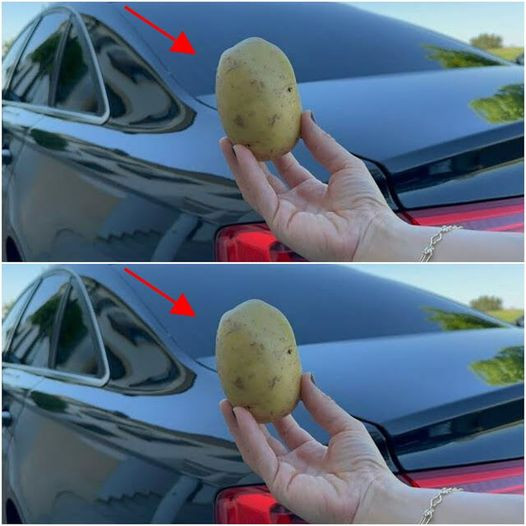
It sounds like something straight out of a quirky survival movie or a farmer’s almanac gone rogue: keep a potato in your car—it might save your life. But like many strange-sounding life hacks that blend folklore with practicality, there’s more to this story than meets the eye. A humble potato, one of the most ordinary items in your kitchen, can actually serve multiple surprising purposes when kept in your vehicle.
Let’s dig deep—literally and figuratively—into how this starchy spud has earned its strange but deserved title as the “lifesaving potato.”
From Kitchen Staple to Roadside Companion
The potato has a long résumé. It’s fed civilizations, sparked revolutions, and adapted to nearly every climate on Earth. But in the past few years, this root vegetable has also become a viral topic online for an entirely different reason: drivers claiming that a potato can make a difference in car emergencies or help with visibility in bad weather.
It may sound absurd, but some of these claims are rooted in truth, while others walk a fine line between myth and science. To understand why so many people are talking about it, we need to explore both the legend and the logic behind this unusual roadside tip.
The Origin of the “Potato in the Car” Trick
The idea of using potatoes for car safety likely began in northern Europe, where drivers have long battled icy windshields and foggy mornings. Sometime in the mid-20th century, people discovered that rubbing a raw potato on a car’s windshield could help prevent fogging and even delay ice buildup.
It wasn’t witchcraft—it was chemistry. Potatoes contain starch and sugar compounds that form a thin, invisible film when applied to glass. That film slightly repels moisture and makes it harder for condensation or frost to cling.
So, before fancy de-icing sprays or anti-fog coatings existed, people reached for what they already had in their pantry. And the potato, it turned out, was a practical and inexpensive tool.
How a Potato Can Save the Day (and Your Visibility)
Let’s start with the most well-known benefit: the anti-fog trick.
1. The Anti-Fog Hack
If you’ve ever gotten into your car on a cold, damp morning only to have the windows immediately fog up, you know how frustrating—and dangerous—it can be. Visibility is everything when driving, and wiping the windshield with your sleeve only smears the fog around.
Here’s where the potato comes in.
How to do it:
- Cut a raw potato in half.
- Rub the cut side directly on the inside of your windshield, making sure to cover the glass evenly.
- Let it dry for a few minutes, then gently buff with a clean cloth or paper towel.
The science:
The thin layer of starch from the potato forms a barrier that reduces the surface tension of water droplets. Instead of fogging up in small beads, moisture spreads more evenly, preventing opaque patches from forming.
The result? A clear windshield, even when the air inside your car is warm and humid.
It’s not a permanent solution—reapply every few days if needed—but for emergency use, it’s a lifesaver when you can’t wait for defoggers to kick in.
2. The Ice-Prevention Trick
In freezing weather, car windows and mirrors often freeze overnight, making early mornings miserable. But rubbing a potato over your windshield the night before can help here too.
The sugars and starch in the potato act as a natural antifreeze coating, reducing frost adhesion. When you wake up the next morning, you’ll find the ice thinner, softer, and easier to scrape off.
It doesn’t stop frost entirely, but it can buy you time and spare you from the dreaded “credit card scraping” technique.
3. Emergency De-Fog on the Go
Suppose you’re driving and your car’s ventilation system fails—or worse, your defogger just stops working mid-trip. A spare potato in your glove compartment can temporarily save the day.
Slice it in half and gently wipe the inside of the windshield with it. It’s not elegant, and yes, it’ll smell faintly like French fries for a bit, but it will restore visibility long enough to get you home safely.
Other Clever (and Surprising) Uses for a Potato in Your Car
Believe it or not, the potato’s usefulness doesn’t stop at fighting fog. Its natural composition—rich in moisture, starch, and mild acidity—makes it handy in other ways too.
1. Removing Rust Spots
Got a little rust on your car’s chrome or tools in the trunk? Slice a potato, sprinkle some baking soda or dish soap on the cut side, and rub it onto the rust.
The oxalic acid in the potato reacts with the rust, breaking it down gently without damaging the metal. It’s a trick mechanics have used for decades to restore small parts.
2. Emergency Cleaning Tool
A potato can double as an improvised cleaning sponge. In dusty or muddy environments, especially when traveling off-road, a potato’s starchy interior can absorb grime and even buff glass surfaces in a pinch.
3. Moisture Absorber
Believe it or not, a raw potato can help reduce humidity in enclosed spaces. If you leave one (unpeeled) in your car during a damp winter, it can absorb a surprising amount of excess moisture overnight—keeping your windows clearer and your car interior fresher.
4. Emergency Battery Aid (Myth vs. Fact)
You might have heard stories about using potatoes to power light bulbs or jumpstart electronics. While it’s true that potatoes can generate a mild electric current when paired with metal electrodes, this won’t start your car (sorry, MacGyver).
However, the idea itself—using the potato’s electrolytes to produce current—reminds us how biologically charged this humble vegetable really is.
A Practical Trick That’s Also a Lesson in Simplicity
What makes the potato-in-the-car hack so interesting isn’t just that it works—it’s that it reminds us how simple, natural solutions can still outsmart modern problems.
Today, we have anti-fog sprays, defogging systems, and fancy coatings that cost ten times more than a potato. But in essence, they’re doing the same thing: creating a film that changes how water behaves on a surface.
It’s proof that innovation doesn’t always mean complexity. Sometimes, the smartest solution is the one that’s been sitting quietly in your pantry all along.
The Chemistry Behind It All
Let’s dive a little deeper into the potato’s secret powers.
When you cut a potato, you expose amylose and amylopectin, two types of starch molecules. These compounds are hygroscopic, meaning they attract and hold onto water molecules. When spread thinly across a glass surface, they create a semi-hydrophobic (water-repelling) layer.
This layer doesn’t allow water vapor to form distinct droplets—the tiny “fog beads” that scatter light and obscure vision. Instead, moisture spreads into a thin, transparent film, keeping visibility clear.
In cold conditions, the sugar content in the potato also helps by lowering the freezing point of water slightly. This is why the coating helps delay frost buildup—it’s not antifreeze in the chemical sense, but it mimics the same principle on a smaller scale.
Can It Really Be Called “Lifesaving”?
Click page 2 for more