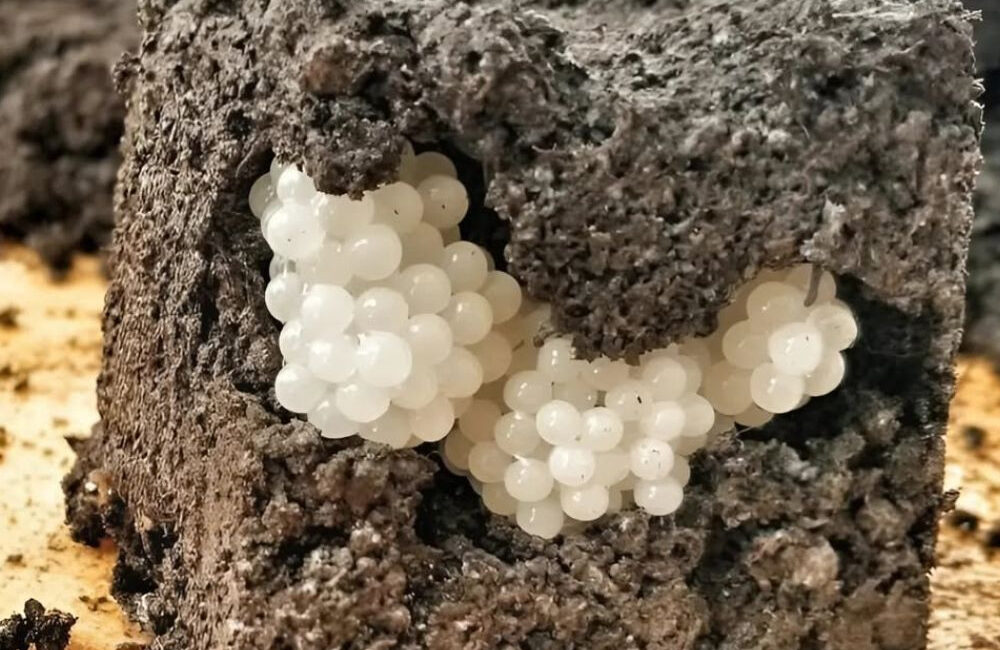
They hatch within 2 to 4 weeks, depending on temperature and moisture. The baby snails emerge translucent and tiny, immediately beginning to eat organic matter—often your garden plants.
So yes, it was natural. But not exactly pleasant.
Snail eggs can survive for weeks, even months, if undisturbed. And if you have a large garden, one cluster can multiply into hundreds of snails within a single season.
What to Do If You Find Them
If you ever find small, jelly-like white balls in your yard, don’t panic—but also, don’t ignore them.
- Confirm they’re not reptile or amphibian eggs.
Frog or toad eggs are usually found in or near water and often come in larger jelly masses rather than individual pearls. Snake eggs are leathery, oblong, and buried deeper in dry soil. - Check for snails or slugs nearby.
If you see silver trails or half-eaten leaves, you’ve found your culprit. - Dispose of them carefully.
You can remove the eggs by scooping them out with a trowel and discarding them in a sealed plastic bag. Do not throw them into compost or flowerbeds—they’ll just hatch and return. - Prevent re-laying.
Snails prefer moist, shaded soil. Try to reduce excessive watering at night, keep the ground turned occasionally, and sprinkle a natural deterrent like crushed eggshells, coffee grounds, or diatomaceous earth. - Encourage natural predators.
Birds, frogs, and beetles help control snail populations naturally.
The Science Behind Their Strange Beauty
Once I got over the initial fear, I couldn’t help but be fascinated. Snail eggs are strangely beautiful—tiny worlds of life suspended in clear spheres, each one holding a microscopic heartbeat of nature.
Their structure is designed for survival: a flexible, semi-permeable membrane that lets in moisture but protects from desiccation; a calcium layer that hardens slightly over time; and just enough oxygen exchange to sustain the embryo until hatching.
Nature, even when unsettling, is brilliant.
And while it’s true that snails can become pests, their eggs also represent an intricate piece of the ecosystem. In healthy soil, everything has its place—snails aerate earth, feed on decaying matter, and serve as food for birds and small mammals.
The balance, as always, is delicate. Too many snails, and your plants suffer. Too few, and other species lose a food source.
From Horror to Understanding
That evening, I returned the eggs to the edge of the yard—far from the vegetable patch this time—and covered them lightly with leaves. I didn’t crush them. Somehow, after all that research, it didn’t feel right.
There was something oddly humbling about realizing I’d been holding a cluster of tiny lives in my gloved hands—fragile, translucent futures waiting under the soil.
I stood there for a long time, the setting sun painting the garden gold, and thought about how easily fear turns into fascination once you understand what you’re looking at.
Those white, jelly-like spheres had gone from horrifying to oddly beautiful in a matter of hours.
A Final Reflection
What began as a moment of dread turned into an unexpected lesson about observation. The world beneath our feet is alive—teeming with mysteries we rarely notice. Sometimes, what looks alien or disturbing is simply nature doing what it’s done for millions of years.
The next time you see something strange in the soil, take a closer look. Put on gloves, sure—but also bring your curiosity. Because whether it’s snail eggs, mushroom spores, or some new life form beginning its cycle, it’s a reminder of how much life hides quietly around us, waiting to be seen.
And as for those white balls in my yard—
They’re gone now. The soil is smooth again.
But every time I walk past that corner, I can’t help but wonder how many tiny shells might already be gliding silently under the leaves.