While functionality dominates, aesthetics also matter. Designers often use the hole as a visual focal point to make a stool look lighter, more modern, or symmetrical.
A solid stool can appear bulky, especially in vibrant colors. Adding a hole gives it a visual balance, reducing the sense of heaviness. In minimalistic or contemporary design, negative space (empty space like a hole or cutout) creates harmony and sophistication.
Some designers even experiment with:
- Different hole shapes – circles, squares, ovals, or artistic cutouts.
- Contrasting colors – with inner rims or dual-tone finishes.
- Brand logos or patterns incorporated into the hole design.
The hole, therefore, doubles as a design signature—a simple way to make a utilitarian object look appealing and distinctive.
The Environmental Angle: Saving Resources and Reducing Waste
Every gram of plastic saved in production helps reduce resource consumption and environmental impact. That small circular gap in the seat might seem trivial, but multiplied across millions of stools, the savings are significant.
Manufacturers estimate that the hole can reduce material usage by up to 5–8% per stool. That means less plastic resin is needed, leading to:
- Lower carbon emissions during production.
- Reduced energy usage for heating and molding.
- Less waste when recycling or disposing of old stools.
In a world increasingly conscious about sustainability, even a small feature like this reflects eco-smart design. It proves that thoughtful engineering can create better, greener products without compromising durability or comfort.
Ergonomics: Comfort Beyond Convenience
The hole isn’t just functional; it contributes to comfort as well.
When seated for long periods, having a solid, flat surface can trap heat and moisture between the body and the seat. The hole allows a bit of air circulation, making the seat cooler and more comfortable.
In ergonomic design, airflow and pressure relief are small but meaningful details. This is why some plastic stools used in spas or saunas feature multiple ventilation holes instead of one.
So, even in its simplest form, the hole improves user comfort—especially in warm or humid environments.
Safety for Children and Seniors
Plastic stools are often used by children (for brushing their teeth, reaching sinks, or sitting during play) and elderly individuals (for bathing or mobility support).
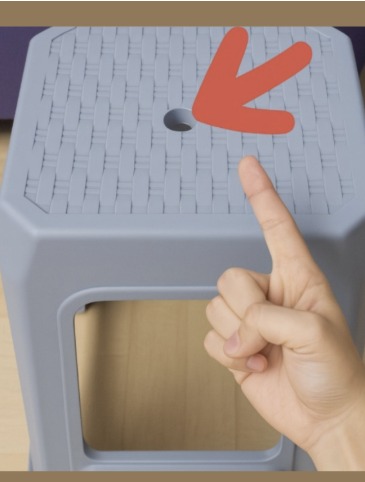
The hole improves grip, safety, and control during handling. When a stool has to be moved from one room to another, the center hole ensures users can hold it securely, even with wet or small hands.
Additionally, if a child tips a stool upside down or plays with it, the hole prevents air pressure buildup—reducing the risk of suction injuries or accidents.
For elderly users, it eliminates the need to bend or twist awkwardly when lifting the stool from the floor—simply inserting fingers into the hole provides an easy and ergonomic way to move it.
Design Innovation: From Simple Hole to Smart Functionality
Over the years, stool manufacturers have taken the humble hole and reimagined it creatively.
Some modern innovations include:
- Detachable inserts: allowing the hole to double as a storage pocket.
- Built-in handles: shaped around the hole for improved ergonomics.
- Drainage systems: in outdoor or bathroom stools where water needs to pass through easily.
- Brand personalization: embedding logos or patterns in the hole area.
These innovations show how a single design element can inspire new uses and aesthetic variations, turning practicality into brand identity.
The Psychological and Marketing Perspective
Consumers often gravitate toward designs that “feel” right, even if they can’t explain why. The hole in a stool adds an element of approachability—it looks friendly, simple, and easy to use.
In marketing psychology, products that communicate ease, lightness, and safety perform better. The open space signals functionality and cleanliness, two major factors in consumer preference.
That’s why you’ll rarely find modern plastic stools without this feature. It’s not just engineering—it’s also about design psychology and consumer trust.
Symbolism and Cultural Associations
Interestingly, even such a simple feature has symbolic significance in some cultures. The circular hole represents completeness, balance, and utility—a reminder that simplicity can embody intelligence.
In minimalistic design philosophies, especially in Eastern cultures, a circle or empty space often symbolizes purposeful emptiness—something that fulfills a role by not being there.
Thus, the hole embodies a subtle design philosophy: removing what isn’t necessary often enhances what remains. It’s a lesson in both design and life.
Engineering Insight: Stress Flow and Material Science
Let’s take a brief technical detour.
When a stool is used, it experiences load stress, torsion, and thermal expansion. A solid seat without any central void would accumulate stress in the middle, especially during repeated use. Over time, this leads to cracking or surface fatigue.
The hole distributes this stress evenly, preventing micro-fractures and extending the stool’s lifespan. It’s a practical example of material optimization, similar to how engineers use honeycomb structures or perforations in industrial components to maintain strength while saving material.
This design principle is called “structural minimalism”—achieving maximum strength with minimum material. The plastic stool is a textbook example of it in everyday life.
Adapting the Hole for Different Environments
Not all stools are created equal. Manufacturers adapt the hole’s size, shape, and position depending on the stool’s intended use.
Bathroom Stools:
- Larger, rounded holes for better drainage.
- Textured rims for non-slip handling.
- Water-resistant finishes to prevent bacterial buildup.
Outdoor or Garden Stools:
- Wider holes for easy carrying and hanging.
- UV-resistant materials for sunlight exposure.
- Sometimes include slots for water runoff during rain.
Kitchen or Household Stools:
- Medium holes that balance comfort and portability.
- Color-matched designs that blend with home interiors.
Industrial or Commercial Stools:
- Reinforced rims for heavy-duty strength.
- Grip holes for quick movement during cleaning or rearrangement.
These subtle variations prove how one small feature can adapt to vastly different functional environments.
Beyond the Stool: The Broader Design Lesson
The story of the hole in a plastic stool isn’t just about furniture—it’s a case study in design intelligence. It shows how thoughtful simplicity can yield multiple benefits across usability, manufacturing, cost, safety, and sustainability.
Every well-designed product incorporates these same principles:
- Functionality: Solve a real problem.
- Efficiency: Use only as much material and energy as necessary.
- User experience: Make the product intuitive and comfortable.
- Aesthetics: Appeal to both logic and emotion.
The stool hole checks every box. It’s a micro example of macro design thinking—proof that innovation doesn’t always require complexity.
Maintenance and Longevity: Caring for a Plastic Stool
Because of the hole’s design benefits, maintenance is remarkably easy. However, proper care ensures your stool lasts for years.
Tips:
- Clean regularly with mild soap and water.
- Avoid abrasive scrubbers that can scratch the plastic.
- Store indoors or under shade to prevent UV discoloration.
- Dry completely after use in wet areas.
The hole allows airflow and drainage, so you can easily hang the stool to dry or rinse it without residue collecting underneath.
Many users also hang stools through their holes on wall hooks—a space-saving and hygienic storage method.
Economic and Industrial Impact
From a manufacturing standpoint, the design of a simple hole significantly affects production economics.
- Reduced raw material consumption means lower cost per unit.
- Faster cooling times lead to higher production output.
- Simplified molds reduce maintenance and error rates.
This efficiency translates to lower retail prices, making plastic stools among the most cost-effective household items worldwide. It’s a fine example of how design efficiency creates economic scalability.
The Future of Smart Plastic Furniture
As design evolves toward sustainability and smart home functionality, even simple furniture like stools is undergoing transformation.
Future versions may integrate:
- Biodegradable plastics or recycled materials.
- Smart sensors for weight capacity or usage tracking.
- Modular components that stack and connect for multiple uses.
Still, the central hole will likely remain—proving that some features are simply too perfect to change. It’s the essence of timeless utility.
Final Thoughts: The Intelligence of Simplicity
At first glance, the hole in a plastic stool seems like a minor feature—an aesthetic quirk or manufacturing convenience. But as we’ve explored, it’s far more than that. It’s a multi-functional innovation that enhances portability, safety, durability, efficiency, and comfort, all while reducing environmental impact.
It represents the philosophy that good design hides in plain sight. The best ideas aren’t always complex; they’re often the ones that quietly make our lives easier every single day.
So, the next time you grab a plastic stool by its handle hole, remember: that small circle isn’t just empty space—it’s a symbol of smart, purposeful design that balances practicality, economy, and creativity in perfect harmony.