Violators can face criminal charges, fines, and imprisonment, as well as civil lawsuits for emotional and psychological harm.
Business owners are legally obligated to ensure that fitting rooms and restrooms are safe, private, and compliant with building and consumer protection laws.
Consumers, on the other hand, are encouraged to remain alert and report suspicious activity.
The Psychology Behind Feeling Watched
Humans have a natural sense of awareness known as the “sixth sense” — that instinctive feeling when something doesn’t feel right. Psychologists call it hypervigilance, an evolutionary trait linked to survival.
When you step into a fitting room or bathroom and suddenly feel uneasy, there’s often a reason. The environment might have subtle cues:
- Odd lighting
- Unusual reflections
- Quiet humming sounds
- Strange wall structures
Trusting your instincts is crucial. It’s not paranoia; it’s self-protection.
The Rise of Hidden Surveillance Technology
Over the past decade, hidden camera technology has advanced rapidly. Miniature lenses can now fit into everyday objects — pens, smoke detectors, wall screws, or alarm clocks. Some two-way mirrors even conceal Wi-Fi-enabled cameras behind reflective surfaces, streaming live footage to remote devices.
These devices are disturbingly cheap and easy to purchase. That’s why vigilance and awareness are more important than ever.
Even though authorities have become better at regulating privacy violations, prevention still begins with individual awareness.
How to Protect Your Privacy Everywhere
Here are additional safety practices beyond mirror tests that can help protect your privacy in public and private spaces:
- Inspect rooms before settling in: Look for any lenses, flashing lights, or small holes in walls.
- Use your phone’s camera: In low light, hidden infrared cameras sometimes show up as small red or purple dots through your camera lens.
- Cover suspicious objects: If you can’t confirm their purpose, use tape, towels, or clothing to block potential lenses temporarily.
- Use portable anti-surveillance gadgets: There are compact scanners that detect wireless cameras or transmitters.
- Check lighting and ventilation areas: Hidden cameras are often installed near lights or air vents to blend in.
Simple awareness can go a long way in protecting your personal security and peace of mind.
Cultural Curiosity: Why Mirrors Fascinate Us
Mirrors have always held a mysterious place in human culture. Across history, they’ve symbolized truth, illusion, vanity, and self-reflection. From fairy tales like Snow White to the science of optical illusions, mirrors blur the line between reality and perception.
This cultural fascination can sometimes overshadow their practical function — until that function is violated. When a mirror ceases to be just a reflective surface and becomes a window for hidden observation, it strikes at something primal: our need for safety in privacy.
That’s what makes understanding and recognizing a two-way mirror so empowering. It turns fear into control.
Recognizing Red Flags in Commercial Spaces
Certain signs can help you identify questionable setups in stores, hotels, or restrooms:
- Unusually bright lighting focused on mirrors.
- Mirrors covering entire walls, especially from floor to ceiling.
- Thick frames or suspicious wiring near the mirror.
- Lack of ventilation gaps or small hidden holes near fixtures.
- Odd employee behavior discouraging customers from inspecting mirrors.
Whenever you notice something that doesn’t align with standard room design, it’s worth taking a closer look.
Practical Example: How to Check a Fitting Room Safely
Let’s walk through a real-world scenario step by step.
You enter a fitting room to try on clothes. Here’s what you do:
- Observe the room layout. Look at the ceiling, walls, and lighting placement.
- Check for cameras. Use your phone’s flashlight to scan corners or overhead vents.
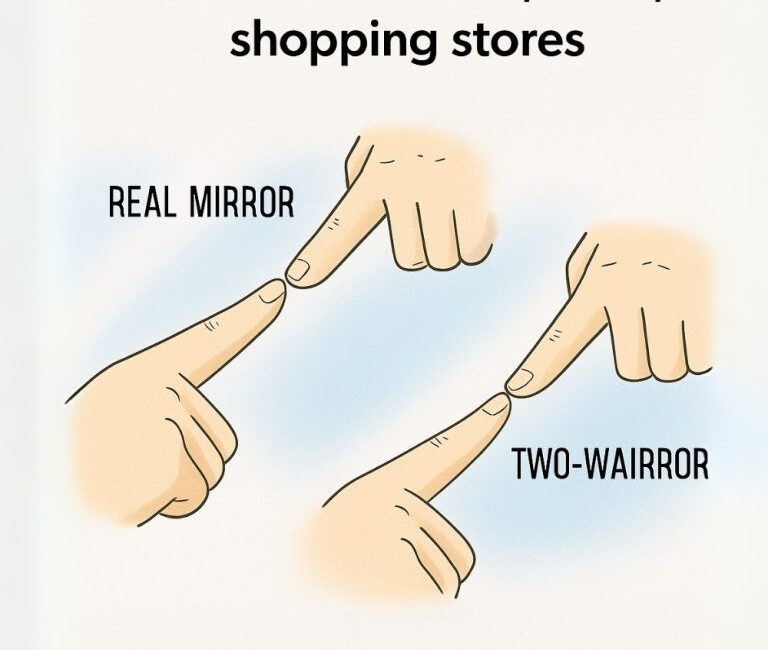
- Inspect the mirror. Do the fingernail test and tap test.
- Note reflections. Look for inconsistencies or areas that seem too dark behind the mirror.
- Use your intuition. If something feels off, don’t ignore it. Leave the room and report it immediately.
This entire process takes less than a minute but could protect you from a severe invasion of privacy.
The Importance of Spreading Awareness
One of the most effective ways to combat hidden surveillance is through education and awareness. When people understand what to look for, potential abusers lose their power.
Sharing this knowledge with friends, family, and colleagues can make a real difference. Many cases of hidden cameras and two-way mirrors have been exposed because someone knew what signs to look for.
Empowerment begins with information — and vigilance.
Technology’s Role in Protection
While technology can be used to invade privacy, it can also help safeguard it.
Modern smartphones and home security tools can:
- Detect hidden cameras using infrared sensors.
- Scan for Wi-Fi networks that belong to spy devices.
- Capture evidence discreetly if something seems wrong.
Portable privacy detectors and anti-spy scanning devices are becoming popular among travelers, digital nomads, and professionals who stay frequently in hotels or shared accommodations.
It’s a small investment for significant peace of mind.
Legal Rights and Reporting
If you ever discover a two-way mirror or hidden camera in a private space:
- Do not confront the suspected observer directly.
- Collect evidence — photographs, videos, or detailed notes of what you found.
- Leave the area and contact local law enforcement immediately.
- In commercial settings, you can also contact consumer safety agencies or privacy advocacy organizations.
In many regions, filming or observing someone without consent in a private setting is categorized as voyeurism or illegal surveillance, carrying severe penalties.
Knowing your rights ensures you can take the right action confidently.
Emotional Aftermath and Healing
Discovering a hidden camera or two-way mirror can be deeply distressing. Victims often describe an ongoing sense of being watched, even after the incident. It’s important to seek emotional support — talk to trusted friends, family, or professional counselors.
Healing involves regaining control over your environment and restoring your sense of safety. Taking proactive steps, such as learning privacy protection measures, can help rebuild confidence.
Why This Knowledge Matters
We live in an era of constant observation — security cameras, data tracking, smart devices, and digital footprints surround us. But there’s a vital difference between consensual monitoring and invasive surveillance.
Knowing how to tell the difference between a real mirror and a two-way mirror is not just a novelty — it’s an act of personal empowerment. It represents awareness, control, and the right to choose when and how you’re seen.
As privacy becomes increasingly rare, these small life tips become essential tools for modern living.
Final Thoughts: Look Beyond the Reflection
The next time you stand before a mirror in a fitting room, take a moment to look beyond your reflection.
That moment of awareness can be the difference between comfort and vulnerability, between safety and exposure.
A mirror should show your image — nothing more, nothing less.
By learning to recognize the signs of a two-way mirror, you protect not only your privacy but your peace of mind.
Remember:
- Trust your instincts.
- Use the simple tests.
- Speak up if something feels wrong.
Privacy is not a privilege; it’s a basic human right. And sometimes, protecting it starts with something as simple as looking a little closer at the mirror in front of you.