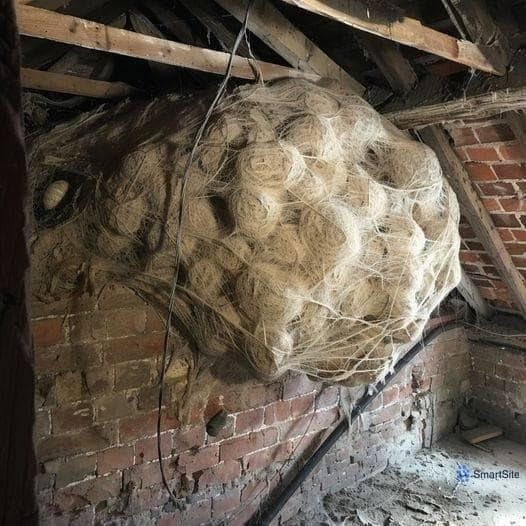
Over time, both father and son began to see the situation not merely as a household inconvenience but as a lesson in observation, patience, and the hidden wonders of their environment.
Understanding the Science Behind It
While the family could only speculate, the scientific implications were profound. Potential explanations for the attic inhabitants included:
- Previously Undocumented Insect Species:
- Adapted to human environments and capable of surviving in hidden spaces.
- Demonstrated intelligence through organized structure and communication.
- Environmental Displacement:
- Disruptions in the local ecosystem, such as the deer damaging trees, may have forced species to adapt in unusual ways.
- The east yard structure could serve as a survival hub.
- Behavioral Adaptation:
- The creatures’ unique activity patterns suggested they were learning from their environment.
- Interaction with the household may have influenced their social behaviors.
Regardless of the exact taxonomy, the attic discovery highlighted the hidden complexity of everyday environments, where human activity and nature intersect in unpredictable ways.
Lessons Learned from an Unexpected Discovery
This story, while shocking, offers several insights for homeowners, parents, and anyone interested in the mysteries of the natural world:
- Pay Attention to Small Signs:
- Minor disruptions in your property can indicate larger hidden phenomena.
- Unusual sounds, small movements, or structural anomalies should never be ignored.
- Safety First:
- Approach unknown creatures with caution. Protective gloves, distance, and controlled observation are essential.
- Avoid impulsive attempts to remove or destroy nests without understanding the species.
- Document Everything:
- Photos, videos, and detailed notes can help identify the species and understand their behavior.
- Documentation is critical if professional consultation is necessary.
- Children’s Perspective Matters:
- Kids often notice things adults overlook. Liam’s cries led James to the attic discovery.
- Encouraging curiosity while teaching caution can transform fear into learning.
- Human and Nature Interconnection:
- The backyard damage and the attic colony were indirectly linked.
- Human interventions, even minor, can have unforeseen ecological consequences.
The Resolution and Future Precautions
After weeks of careful observation, James implemented measures to manage the attic colony without harming it:
- Blocked non-essential entry points to limit movement inside the home.
- Monitored the yard structure to ensure no further expansion into the house.
- Established a safe observation routine for Liam, turning fear into educational opportunity.
The experience transformed the family’s approach to home maintenance. What began as a potential hazard became a window into hidden ecosystems, teaching them that sometimes the most extraordinary discoveries lie in spaces we overlook every day.
Conclusion
James’s discovery in the attic reminds us that the ordinary can mask the extraordinary. What seemed like hornets, a simple household nuisance, turned out to be a complex colony of unknown creatures with surprising intelligence and organization. Through careful observation, thoughtful safety measures, and curiosity-driven investigation, a frightening moment became a profound learning experience for both father and son.
The story also underscores a larger truth: our environments are alive with mysteries, waiting for those willing to look closely. Every sound in an attic, every movement in the yard, may hold the key to secrets that redefine our understanding of nature and its resilience.
For James and Liam, the attic is no longer just storage space. It is a symbol of discovery, connection, and the hidden wonders of the world around us. And for anyone who hears unexplained cries or sees unusual structures, it is a gentle reminder to pause, investigate, and embrace the unknown—because sometimes, what we fear may just be the doorway to an incredible story.