Because the loop is central, many design variants explore alternate hinge or loop forms. Let’s look at some:
Double Coil / Dual Loop Designs
Some safety pins use a double coil (two small loops side by side) or a spiral twist instead of a single loop. These designs can offer higher spring tension, redundancy, or smoother motion.
Miniature Micro‑coils
In very small or specialized safety pins (for delicate fabrics, medical or jewelry use), the loop becomes micro‑scaled. It is often extremely tight and nearly invisible, yet engineered to maintain function while minimizing bulk.
Plastic / Composite Hybrid Hinges
Some modern pins, especially in novelty or lightweight use, replace the metal loop with a molded plastic hinge or use hybrid metal/plastic materials. In these, the “loop” may be a molded bend or synthetic spring region, but it still acts like that traditional small circle.
Decorative or Symbolic Loops
In some designer pins, the loop is exaggerated, stylized, or shaped into decorative forms — hearts, circles, spirals — merging function and art. But even in those, the loop is not just aesthetic — it still must store spring tension.
Safety Enhancements & Enhanced Loops
High-end or specialty safety pins may augment the loop with design enhancements: strain relief geometry, thicker coil cores, or shaping that reduces fatigue. For heavy-duty use (blanket pins, pinning thick material), the loop is oversized or reinforced.
Thus, the loop region is a zone of innovation. Designers continually tweak radius, number of turns, cross-sectional thickness and curvature to balance flexibility, strength, fatigue resistance, and size.
Hidden Meanings & Symbolism of the Loop
While the small circle is primarily mechanical, humans are meaning‑makers. Over time, people have attributed symbolic meaning to safety pins and even the loop itself. Below are interpretive layers — not strictly functional, but culturally potent.
Safety, Protection & Holding Things Together
The safety pin is symbolic of holding things together, of unity, of mending, of protection. The little loop is part of that symbolism — the circular shape evokes continuity, bond, and safeguarding. It is like a seal of secure connection.
When someone gives a safety pin, or pins something, it is metaphorically “keeping it safe” or “holding things in place.” The loop reinforces that — literally binding the components.
Continuity & Circularity
Circles often represent infinity, cycles, wholeness, unity. The loop in a safety pin can be read as a micro symbol of continuity — the system is closed, self‑sustaining: the point always returns to the catch, the pin returns to a safe state. In a symbolic reading, it speaks to completeness and safety.
Hidden Strength in Minimalism
The loop is also a metaphor for hidden strength. You don’t see a coil of steel and expect it to exert force, yet it does. It’s a quiet power, folded into a humble form. Some see that as a metaphor for quiet resilience, hidden potential, small mechanisms that sustain entire systems.
Symbol in Fashion, Identity & Solidarity
In modern cultural contexts, safety pins are used as symbols (for instance as signs of solidarity, as markers that “you are safe with me”). The loop is part of the visible silhouette — the pin is recognized partly by that distinctive looped hinge. So in a necklace, brooch, or wearable symbol, the loop is part of the iconography.
Thus, even when worn as a statement, the loop is not irrelevant fluff — it is part of what people instantly recognize as a “safety pin shape,” contributing to symbolic meaning.
Why You Didn’t Know: The Loop’s Invisible Genius
So why do so many people never ask about or notice that little loop? Because it is invisibly essential. Here are reasons:
- Subtlety by design: The loop is small, smooth, integrated. It doesn’t scream “look at me.” It silently does its work.
- Taken for granted: Safety pins are ubiquitous, everyday tools. We rarely reflect on them — especially on their internal mechanism.
- Hidden inside structure: The loop is often tucked at the bend or hinge, not visually prominent when the pin is fastened.
- Lack of mechanical training: Most people aren’t taught to see everyday objects as mechanical systems.
- Familiarity breeds blindness: Over years, we stop noticing details that always existed.
Because the loop is so elegantly disguised and seamlessly functional, it becomes invisible — until someone asks, “Why is that there?” And then you realize: That’s the secret core of the safety pin’s brilliance.
Exploring the Loop in Different Types & Applications
Let’s now examine how the small circle/loop appears (or changes) in various types of safety pins and uses.
Standard Clothing Safety Pins
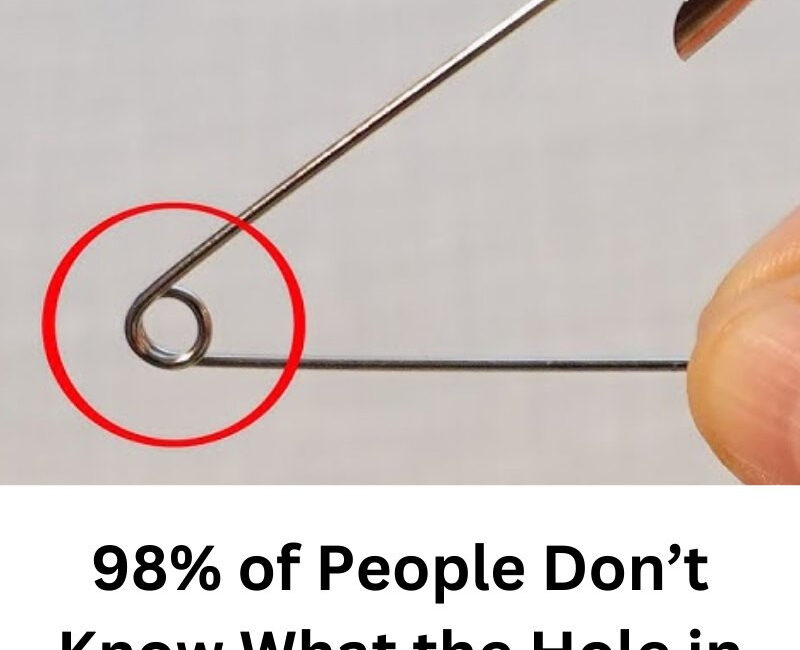
Everyday safety pins have a modest, visible loop at the hinge. That loop is typically a single coil. It is sized so that opening is smooth, closing clicks securely, but overall size remains minimal.
If you disassemble (carefully) an old pin, you’ll see slight variation — some loops tighter, some looser. Those differences affect feel and durability. The loop’s radius, number of turns, and wire gauge all interplay.
Quilting / Blanket / Large Safety Pins
Bigger safety pins used for heavy fabrics or quilting often have larger or reinforced loops. Because thickness of material is greater, spring tension requirements increase; thus the loop may be more robust, sometimes multi-turn or extra diameter, to provide stronger spring force.
In those, the loop may be more visible and robust — you can feel its presence when manipulating the pin.
Fuse Pins, Specialty Pins & Industrial Variants
In technical uses (e.g., pins in machinery, safety latches, removable fasteners), the “loop” region may evolve into a spring clip, torsion coil, or even multiple loops. But conceptual analogy remains: the hinge or coil stores energy, ensures positive closure, and resists accidental opening.
In such industrial pins, the loop is often deliberately emphasized for strength and longevity.
Novelty & Decorative Safety Pins
Some fashion pins intentionally exaggerate the loop — turning it into a spiral, a heart, or decorative swirl. But even then, the loop remains functional: retaining spring force, locking the clasp. Thus, the aesthetic loop merges function and artistry.
When someone wears a safety pin as jewelry, part of its character — and its identity — is the loop’s silhouette. It is part of how you recognize a pin at a glance.
How to Inspect, Understand & Appreciate the Loop Yourself
Here’s how you can explore the little circle in your own safety pins (or pins you find):
- Take several safety pins (various sizes) and hold them close. Notice the hinge area. You’ll see the loop, sometimes faint, sometimes prominent.
- Gently open and close the pin and feel resistance. That resistance is coming from the loop spring. Try loosening or bending the loop slightly (if you have a sacrificial pin) and feel how closure weakens.
- Backlight or magnify the loop area to see the thin bends and curvature. You’ll see how the loop wires overlap, how it is shaped.
- Compare old vs. new pins. Old pins may have thicker, more visible coils (due to lower manufacturing precision). Modern pins often have tighter, subtler loops.
- Look at broken pins. If you dissect a failed pin, often the break will be near the loop or hinge — showing where stress concentrates.
- Sketch or draw the loop geometry: radius, clearance, how many turns. You’ll begin to appreciate how delicate the balance is between loop size, thickness, and spring behavior.
Through this exploration, you’ll see that the loop is not arbitrary — it’s a carefully tuned feature.
Common Misconceptions & Myths About That Little Loop
Because the loop is subtle and mysterious, myths arise. Let’s dispel or clarify them:
- Myth: The circle is decorative only. — False. It is mechanical, essential, and functional.
- Myth: The loop is a place to attach something. — Not really — its size and shape are for spring mechanics, not for hooking or threading (though in decorative pins people may use it).
- Myth: All loops are identical. — No. Loop geometry depends on pin size, metal gauge, intended load, spring tension. A pin designed for thick material will have a different loop than a lightweight fabric pin.
- Myth: If loop is broken or bent, it doesn’t matter much. — Actually, a deformed loop often leads to failure: the pin will not hold tension, the clasp may open under strain, or the pin may fatigue faster.
- Myth: The loop is unnecessary, early pins might have skipped it. — Early fasteners had spring mechanisms or rivets; but a true “safety pin” design always relies on hinge or loop action. The loop is part of what makes it “safe.”
- Myth: You can replace the loop with rubber or other material. — Not effectively. Metal spring action requires elastic properties; substitute materials often degrade, creep, or lose tension over time.
Understanding and rejecting these myths helps you see the loop’s true purpose.
Why So Few People Know This Secret
It’s instructive to understand why this mechanical secret remains unknown to almost everyone:
- Everyday invisibility — Because safety pins are so mundane, we stop observing them.
- Lack of mechanical literacy — Most people don’t study springs, stresses, design geometry in everyday objects.
- Education neglects ordinary things — Schools seldom teach mechanical insight into household objects.
- Mass production hides detail — Modern pins make the loops very subtle, further concealing them.
- Cultural invisibility — The loop is not publicized or appreciated; it lacks glamour or obvious symbolism.
Yet once you know, you’ll see loops everywhere — these invisible helpers are part of daily life.
Why It Matters: Practical & Intellectual Value
You might ask — okay, but why bother knowing about that little loop? Here are compelling reasons:
Improved Use & Maintenance
- If you know the loop provides spring tension, you’ll treat your pins better — avoid bending the loop or overstressing it, avoid cheap pins with weak loops. Use high-quality pins for longer life.
- If your pin fails, you might check loop damage and repair or discard appropriately.
Design Appreciation and Creativity
- For those into sewing, crafting, jewelry design, hardware design — knowing the loop’s function gives insight into how to design better pins, custom fasteners, or decorative variants without sacrificing usability.
Mechanical Education & Curiosity
- Appreciating the loop is a gateway into mechanical thinking — springs, stress, fatigue, geometry. Observing everyday objects with such a lens enhances problem-solving, engineering intuition, and appreciation of design.
Symbolic & Anecdotal Value
- You gain a deeper story to tell — next time someone uses a safety pin, you can explain its hidden secret, making the mundane magical. It becomes a conversation piece, a micro-engineering marvel.
Better Tool Choice
- You can select pins with better loop designs (double coil, reinforced hinge) for heavy or critical use. You’ll understand why some pins cost more — better loop design, superior metal, more robust spring action.
Extended Case Studies: Loop Behavior in Action
We’ll now explore several hypothetical and real cases illustrating how the loop matters in use, wear, failure, and design.
Case 1: A Fashion Designer’s Broken Pin
A dress designer uses safety pins in garments for quick fixes backstage. One day a pin fails — it opens on its own, letting part of the dress flap. Investigation shows the loop (hinge coil) had deformed over repeated use. The designer switches to pins with thicker loops and notices improved reliability.
Lesson: Overuse, twisting, stress can deform the loop. Better loop design matters in high-stakes wear.
Case 2: Quilter’s Large Blanket Pin
A quilter uses large safety pins to hold thick quilting layers. A standard small safety pin fails (loop can’t provide enough tension) and the fabric shifts. Upgrading to blanket pins with oversized loops fixes it.
Lesson: As load and thickness increase, loop size and strength must scale too.
Case 3: Vintage Pin Fatigue
An antique safety pin is found bent and broken near its loop. On microscopic inspection, cracks emanate from the hinge region. The loop geometry was likely marginal for the metal used, leading to fatigue.
Lesson: The loop is often the weak point. That’s why high-quality design emphasizes a generous radius and proper coil form.
Case 4: Custom Decorative Pins
A jewelry artisan makes decorative safety pins with heart-shaped loops. The modified loop still must maintain spring action; if the heart is too tight or angular, the pin fails. Only those who maintain loop curvature (smooth arcs) manage to blend style + function.
Lesson: Even in decorative design, loop integrity is essential; aesthetics must not compromise mechanics.
Practical Tips: How to Choose, Use & Preserve Safety Pins (with emphasis on the loop)
Here are actionable suggestions to get the most from your safety pins, with the loop in mind.
Selection Tips
- Look at the loop: Good pins have a clean, smooth, well-proportioned coil. Avoid pins whose loop is flattened, irregular or rough.
- Gauge and thickness: For heavy fabric or load, choose thicker wire and a proportionately robust loop.
- Spring action feel: When you open/close, it should feel crisp but not stiff; a weak, limp feel often means a poor or degraded loop.
- Brand or quality pins: Higher-end pins often invest in better loop design and metal; cheaper pins may have loop shortcuts.
- Don’t over‑bend: Avoid forcing the hinge beyond its elastic limit or twisting the loop.
Usage Tips
- Open and close gently, along the correct geometric path; avoid forcing direction that stresses the loop.
- For repeated use, occasionally check the loop region for deformation or signs of fatigue. If the loop is distorted, retire that pin.
- Avoid using pins at extreme angles or bending sideways — that stresses the loop more.
- Don’t twist the clasp aggressively — that can creep the loop over time.
Maintenance & Lifespan
- Keep pins dry and free of corrosion. Rust weakens the loop region severely.
- Clean pins occasionally; friction and dust can wear the loop hinge.
- Don’t store bent pins — straightness helps preserve loop integrity.
- If the loop becomes slightly deformed, gently reshape using pliers (with care) to restore shape — only within elastic limits.
Repair & Modification (Advanced)
- If the loop is slightly misshapen, you can carefully anneal and rework (for skilled metalworkers). But this is delicate — misstep and you lose spring action or break the wire.
- In custom jewelry, you may reinforce the loop region by wrapping a tiny additional coil or support — but ensure it does not block motion.
- Always prototype modified pins in non-critical use first.
Symbolic & Metaphorical Extensions: The Loop in Life & Thought
Beyond mechanics, the loop in the safety pin inspires metaphor and reflection.
- Loops as resilience: In life, the ability to bend (flex) yet return to integrity is akin to that spring loop. The safety pin’s loop is a metaphor for bouncing back after stress.
- Small detail holding big systems: A tiny loop controls the strength of the whole pin — similarly, small habits, mindset adjustments, or systems regulate much of our lives.
- Hidden core power: Just as the loop is hidden inside, many powerful influences in our world are unseen — values, beliefs, small structural supports.
- Reconnection, repair, mending: Because safety pins mend, the loop becomes a symbol of restoration. It holds torn edges together, just as empathy binds human wounds.
- Continuous cycle: The circular geometry suggests that things return, come back — resilience, cycles, continuity.
You can draw from that metaphoric richness in writing, design, art, mindfulness, teaching or personal reflection.
Summary & Reflection: From Mystery to Appreciation
So now you know: that small circle in a safety pin is not incidental — it is central. It is the spring, the hinge, the tension store, the stress distributor, the locking margin, the compact mechanical engine. Its geometry is carefully tuned to metal properties, repeated use, and the pin’s purpose.
You didn’t know because it is beautifully hidden and seldom questioned. But now, each time you take a safety pin, you can look at it anew — imagine the micro coil, the stress arcs, the energy stored in that curve. The safety pin changes from simple fastener to marvel of minimal mechanical engineering.