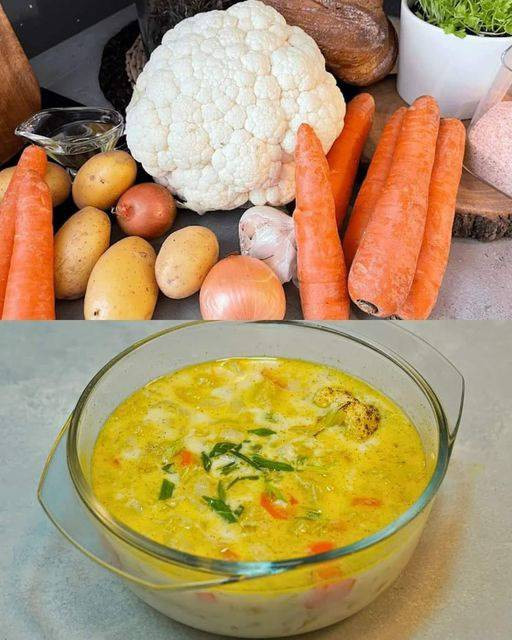
Here’s a sample one‑day meal plan (for someone aiming for ~1,600–1,800 kcal) incorporating this cauliflower soup. (Adjust quantities and sides to your needs.)
| Meal | Menu | Notes |
|---|---|---|
| Breakfast | Oatmeal with berries + one egg (or egg white omelet) | Balanced carbs, protein, fiber |
| Lunch | Cauliflower soup (full serving) + grilled chicken breast + side salad (greens, cucumber, light vinaigrette) | Filling and low calorie |
| Snack | Greek yogurt (low-fat) with a few nuts or sliced fruit | Protein and satisfaction |
| Dinner | Larger vegetable stir-fry or roast vegetables + lean protein (fish, tofu) | Use minimal oil, spice well |
| Optional evening | A cup of herbal tea or bone broth | Helps control late hunger |
You could swap roles: use soup for dinner, have a lighter lunch, etc. The important part is portions, protein, fiber, and satiety.
Over multiple days, you can rotate flavor variations (add ginger, curry, roasted cauliflower garnish) to avoid monotony.
Troubleshooting & Refinement: What to Do When It’s Not Perfect
Even with the best instructions, things occasionally don’t come out ideal. Here’s a guide to common problems and fixes:
Problem: Soup Is Too Thin / Watery
- Option 1: Simmer longer (without lid) to reduce and concentrate.
- Option 2: Add a small extra chunk of cauliflower or potato, boil & blend.
- Option 3: Blend in a small portion of white beans or cooked starchy vegetable.
- Option 4: Slightly increase milk (or use cream or yogurt if diet permits) — but only modestly.
Problem: Soup Too Thick / Pasty
- Add hot water or more milk gradually while stirring to loosen consistency.
- Blend in a little more liquid until desired smoothness is reached.
Problem: Bland / Weak Flavor
- Add salt gradually—taste after each pinch (since salt is potent).
- Add more black pepper or a pinch of heat (red pepper flakes).
- Add a squeeze of fresh lemon juice (acidity brightens flavors).
- Add fresh herbs (parsley, chives) at the end — raw herbs often “pop” flavor.
- Add a hint of garlic, mild spices (cumin, nutmeg) or smoked paprika.
- Use the roasted cauliflower garnish bits (they bring caramel flavor) — stir them in.
Problem: Too Sweet (from carrots / potato)
- Counteract by adding a bit more salt or acid (lemon juice).
- Add a small pinch of savory herb (thyme, oregano) or a mild spice (pepper).
- Blend in a small raw cauliflower piece (less sweet) to dilute the sweetness.
Problem: Grainy Texture or Tiny Bits
- Blend longer or in batches to achieve smoothness.
- Strain the soup through a fine mesh to remove fiber fragments (if texture is unacceptable).
- Use a higher-speed blender or immersion blender carefully.
Problem: Color Loss / Dull Look
- The carrot helps bring warm color — if you reduce carrots, the soup might look pale.
- Garnish with green herbs or bright bits (like parsley, chives) to visually enhance.
- A small dash of paprika or turmeric (tiny) can warm the hue (if it suits taste).
Problem: Reheating Causes Separation or Scorching
- Reheat gently on low to medium heat, stirring frequently.
- Avoid boiling rapidly.
- If it separates or “breaks,” add a splash of milk and whisk briskly to re-emulsify.
- Use a saucepan with a heavy bottom to prevent hot spots.
By diagnosing which issue is affecting you, you can apply the right fix without starting over.
Storage, Meal Prep & Reheating Guidelines
When making soups for convenience and weight management, good storage and reheating practices are essential.
Storage (Refrigeration)
- Let the soup cool to near room temperature (don’t leave out more than ~1 hour) before refrigerating.
- Transfer into airtight containers (glass or BPA‑free plastic) in portioned servings.
- Label date and portion size.
- In the fridge, it’s best consumed within 3–4 days for freshness, flavor, and safety.
Freezing
- Many vegetable soups freeze well.
- Use freezer-safe containers, leaving some headspace for expansion.
- Freeze in individual portions.
- Soup may thicken during freezing; when thawing, gently reheat and stir, adding a bit of milk or water if needed to restore consistency.
- Consume within 2–3 months for best taste.
Reheating
- Thaw in fridge if frozen.
- Reheat on stovetop (low to medium) with stirring to avoid scorching.
- Do not boil vigorously.
- If soup seems too thick after reheating, add fresh milk or hot water gradually while stirring.
- If flavor or texture has dulled, freshen with a squeeze of lemon, a pinch of salt, or a few fresh herbs.
Make‑Ahead Tips
- Roast extra cauliflower in bulk and keep in fridge or freezer to add flavor rapidly in future batches.
- Pre-chop vegetables (onion, carrots, potatoes) and store in airtight bags for faster cooking.
- Pre-portion dry spices so you can toss them in rapidly.
- You can partially cook the vegetables ahead of time (just to soften) and refrigerate; when ready, finish by adding milk, blending, seasoning. But the freshest taste comes from cooking fresh.
Why This Recipe Beats Many “Weight Loss Soups”
It’s helpful to contrast this approach with common pitfalls in “diet soups”:
- Some soups use excess salt or bouillon cubes which lead to water retention or high sodium levels — this recipe keeps salt controllable.
- Some recipes rely on cream or butter to deliver creaminess — this one uses milk (or lighter substitute) plus pureed vegetables for lower fat.
- Many recipes have minimal fiber or too little bulk — here, cauliflower, carrots, potatoes all contribute fiber and volume.
- Many diet soups lack satisfying flavor or texture variation, so people abandon them — here, the roasted cauliflower, herbs, optional protein add-ons, and tweaks keep it interesting.
- Some soups are too watery or too thin — here, the potato plus technique give creamy consistency without excessive calorie load.
Hence, this recipe strikes a balance of flavor, fullness, nutrition, and calorie control — exactly what a smart weight loss soup should do.
Full Example Walk‑Through with Approximate Numbers
Let me walk through a version with approximate calorie/macronutrient accounting (these are estimates; actual values depend on milk type, precise weights, etc.). This helps you see how it fits into a diet.
- Cauliflower (300 g): ~75 kcal, 6 g fiber
- Extra cauliflower (roasting, ~100 g): ~25 kcal
- Onion (1 medium, ~110 g): ~44 kcal
- Carrots (2 medium, ~150 g): ~60 kcal
- Potatoes (2 medium, ~300 g): ~240 kcal
- Milk (3 cups, if using 2% milk): ~300 kcal
- Olive oil for roasting (1 tbsp = ~120 kcal)
- Salt, pepper, thyme (negligible calories)
Total approximate energy: 75 + 25 + 44 + 60 + 240 + 300 + 120 = 864 kcal for entire pot. If you divide into 4 servings, each bowl is ~216 kcal. If into 5, ~173 kcal per bowl. Add in protein side or garnish and your full meal might land at 350–400 kcal — perfect for a weight-loss lunch or dinner.
That math demonstrates how it fits neatly in a sensible calorie budget while being voluminous and satisfying.
Final Thoughts, Tips & Encouragement
- Don’t be afraid to customize the recipe to your preferences (less potato, add spices, tweak garnish).
- The roasted cauliflower step is optional, but strongly enhances flavor — don’t skip twice.
- Use the recipe as a base canvas and rotate flavor profiles (herbs, spices, add-ons) so you don’t get bored.
- Document your own serving sizes and calorie counts as you try it out — that way, you can incorporate it intelligently into your nutrition plan.
- If you find yourself hungry before the next meal, pair the soup with a modest protein or snack (e.g. a boiled egg, Greek yogurt) rather than overburdening the soup itself.
- Use leftovers or make batches for convenience — the easier it is, the more you’ll stick with it.
- Always taste and adjust — small tweaks of salt, pepper, acid (lemon) often transform “just okay” into “delicious.”